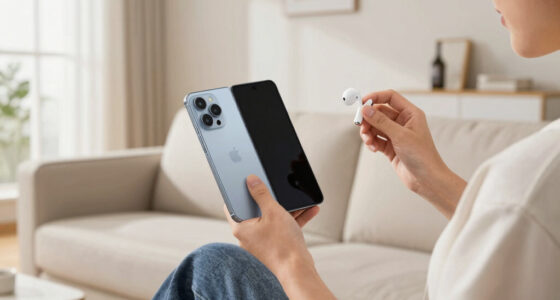
If you have a small, quiet workspace, a headset offers clear audio, noise cancellation, and portability for focused calls. For larger rooms or group meetings, a speakerphone provides better sound coverage, easy hands-free interaction, and fills the space with audio. Your room size, noise level, and how often you’ll move influence your choice. Want to find out which device best fits your environment? Keep exploring to get expert tips tailored for your setup.
Key Takeaways
- Choose headsets for quiet, personal spaces demanding high audio clarity and mobility.
- Opt for speakerphones in larger rooms or group environments requiring hands-free, shared audio.
- Consider room acoustics; speakerphones suit spaces with echoes, while headsets excel in noise-sensitive environments.
- Use headsets for individual tasks and speakerphones for collaborative, multi-participant meetings.
- Portability favors wireless headsets, whereas fixed speakerphones are ideal for semi-permanent setups.
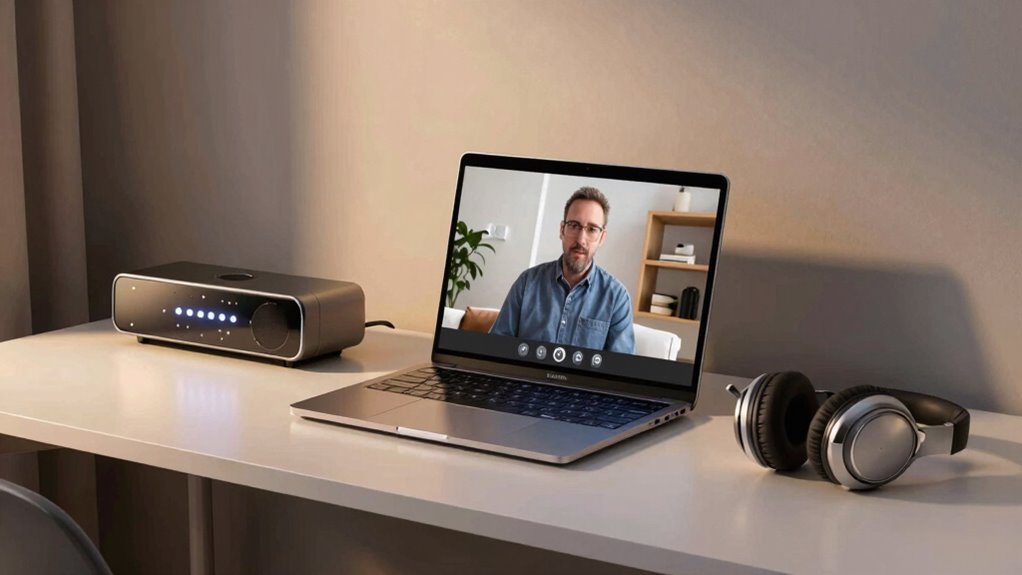
When choosing between a speakerphone and a headset, understanding their advantages can help you make the best decision for your needs. Both options serve different purposes, and knowing their strengths can improve your communication experience. If you prioritize audio clarity, a headset often delivers superior sound quality because it’s designed to isolate your ears from external noise. This guarantees you hear every detail clearly, making it ideal for conference calls, virtual meetings, or any situation where clear communication is vital. Plus, headsets with noise-canceling features can block out background distractions, helping you focus on your conversation. On the other hand, speakerphones excel in offering a more natural, hands-free experience. They fill a room with sound, making it easier for multiple people to participate without everyone needing a device. This broad audio coverage is especially useful in collaborative environments or when you want to share information with a group.
Device portability is another key factor to think about. If you’re frequently on the move or work in different locations, a headset is often more portable. Compact and lightweight, headsets can easily slip into your bag or pocket, allowing you to take calls comfortably without carrying bulky equipment. They also tend to be more discreet, which can be beneficial in public or shared spaces. Conversely, speakerphones are generally larger and less portable. They’re better suited for fixed setups at a desk or in a conference room, where their larger size is less of an issue. While some models are wireless and offer decent portability, they still require a stable surface or space to function effectively. Additionally, understanding the importance of device features can influence your choice, such as battery life, connectivity options, and ease of use. Considering the room size and acoustics can also impact which device performs better in your environment, as larger rooms might benefit from the sound amplification of a speakerphone. Being aware of room acoustics can help you select a device that minimizes echoes or background noise, ensuring clearer communication. Moreover, the environmental noise levels can significantly affect how well each device works in your space.
When deciding which device works better for your room, consider your typical environment. If you mostly work alone or in a quiet space, a high-quality headset might be your best bet for crystal-clear audio and mobility. But if you often have meetings with multiple participants or prefer a hands-free device that everyone can hear, a speakerphone might serve you better. It’s also worth thinking about how often you’ll be moving the device around. If portability is key, a lightweight headset will serve you well. If you’re looking to facilitate group conversations in a semi-permanent location, a speakerphone provides the convenience of shared audio without the need for everyone to wear individual devices. Additionally, selecting a device with adjustable volume controls can help fine-tune audio settings to suit your environment, further enhancing communication quality. Ultimately, matching the device to your space and usage habits guarantees you get the most effective communication experience.

Mopchnic Wireless Headset with Noise Cancelling Microphone, On-Ear Bluetooth Headset with USB Dongle, Mute Function & Charging Base, Wireless Headphones for Work from Home and Call Center (Black)
ENC Noise Cancelling & Clear Calls: This wireless headset blocks most distracting background noise. It effectively filters out…
As an affiliate, we earn on qualifying purchases.
As an affiliate, we earn on qualifying purchases.
Frequently Asked Questions
Do Speakerphones Pick up Background Noise Better Than Headsets?
Speakerphones tend to pick up more background noise than headsets because they use built-in microphones that capture sound from the entire room. This can make voice clarity suffer, especially if your environment isn’t quiet. Headsets, on the other hand, offer better noise suppression, focusing on your voice and reducing background sounds. So, if clear communication is your goal, a headset generally performs better in controlling ambient noise.
Are Headsets More Comfortable for Long Conversations?
Headsets are like a cozy chair for your ears, offering better comfort during long conversations. Thanks to their ergonomic design, they provide long-term comfort by reducing strain and pressure. Unlike speakerphones, which can cause fatigue from holding or leaning into them, headsets support your neck and shoulders, making extended calls more pleasant. If you prioritize comfort, investing in a well-designed headset is the way to go.
Can Speakerphones Be Used Effectively in Large Rooms?
Yes, speakerphones can be effective in large rooms if you consider room acoustics and microphone sensitivity. You should choose a model with a highly sensitive microphone to pick up your voice clearly, even from across the room. Additionally, make certain the room has good acoustics to minimize echo and background noise. Position the speakerphone correctly, ideally closer to you, and use echo-canceling features for better sound quality during calls.
Do Wireless Headsets Have Better Sound Quality Than Wired?
Wireless headsets often offer better sound quality than wired ones because of advanced wireless connectivity technology. You’ll notice clearer sound clarity, especially with high-quality models designed for audio precision. Plus, without tangled wires, you experience more freedom and convenience. However, the actual sound quality depends on the specific headset’s features and build quality. So, choose a reputable brand to guarantee you get the best sound clarity with your wireless headset.
Which Option Is More Secure for Confidential Calls?
Headsets are more secure for confidential calls because they reduce privacy concerns and limit audio leakage. They often feature data encryption, ensuring your conversation stays private. With a headset, you control the environment, preventing eavesdroppers from overhearing. Speakerphones, on the other hand, can broadcast sounds in the room, increasing the risk of data breaches. Opt for a headset to safeguard sensitive information effectively.

Conference Speaker and Microphone, 360° Omnidirectional USB Speakerphone Microphone with USB Hub, Noise Reduction/Echo Cancellation Computer Microphone for 8-10 People Business Conference, Home Office
HD Voice and Crystal Clear Sound: Q95mini USB speakerphone comes with 360° omnidirectional microphone and high-quality speaker, plus…
As an affiliate, we earn on qualifying purchases.
As an affiliate, we earn on qualifying purchases.
Conclusion
Ultimately, choosing between a speakerphone and a headset depends on your needs, your environment, and your comfort. If you value mobility, go for the speakerphone; if you prioritize clarity, opt for the headset. If you want convenience, pick the speakerphone; if you seek privacy, choose the headset. Whether you prefer the loud and shared or the quiet and personal, your choice should match your habits, your space, and your style. Make your decision based on what feels right for you.

Bluetooth Headset V5.3, Wireless Headset with Dual Noise-Canceling Microphones, Portable Charging Case, 300H Standby Time, Hands Free Headphones for Computer/Cell Phones, Trucker/Home/Office/Work
Advanced Noise Cancelling Bluetooth Headset; bluetooth earpiece, equipped with dual microphones and upgraded noise cancelling chip, intelligently recognizes…
As an affiliate, we earn on qualifying purchases.
As an affiliate, we earn on qualifying purchases.
Conference Speaker and Microphone, 360° Omnidirectional USB Speakerphone Microphone with USB Hub, Noise Reduction/Echo Cancellation Computer Microphone for 8-10 People Business Conference, Home Office
HD Voice and Crystal Clear Sound: Q95mini USB speakerphone comes with 360° omnidirectional microphone and high-quality speaker, plus…
As an affiliate, we earn on qualifying purchases.
As an affiliate, we earn on qualifying purchases.