TL;DR

Get comfort and recovery gear delivered free with Prime
- Fast, free delivery on millions of items
- Prime Video, Amazon Music and more included
- Member-only deals all year
Fit&Well published a beginner-friendly, four-pose yoga flow created by Yogalina Studios founder Alina Boyett. The sequence uses gentle stretches and breathing for recovery; claims about how it may feel are attributed to Boyett, and the source does not report clinical evidence or measured outcomes.
Fit&Well has published a beginner-friendly, four-pose yoga flow designed by Alina Boyett, founder of UK-based Yogalina Studios, for gentle movement after exercise or a day spent sitting. The no-equipment sequence includes a legs-up-the-wall rest, child’s pose, a relaxed forward fold and a seated twist; Boyett says to move within a comfortable range and not push through pain.
Boyett told Fit&Well that the sequence focuses on the legs, hips, spine and shoulders, areas she says commonly experience tension after exercise. The poses are intended to be accessible without previous yoga experience or advanced flexibility. The report also features Yogalina teacher Misha Clarke demonstrating the movements in a video.
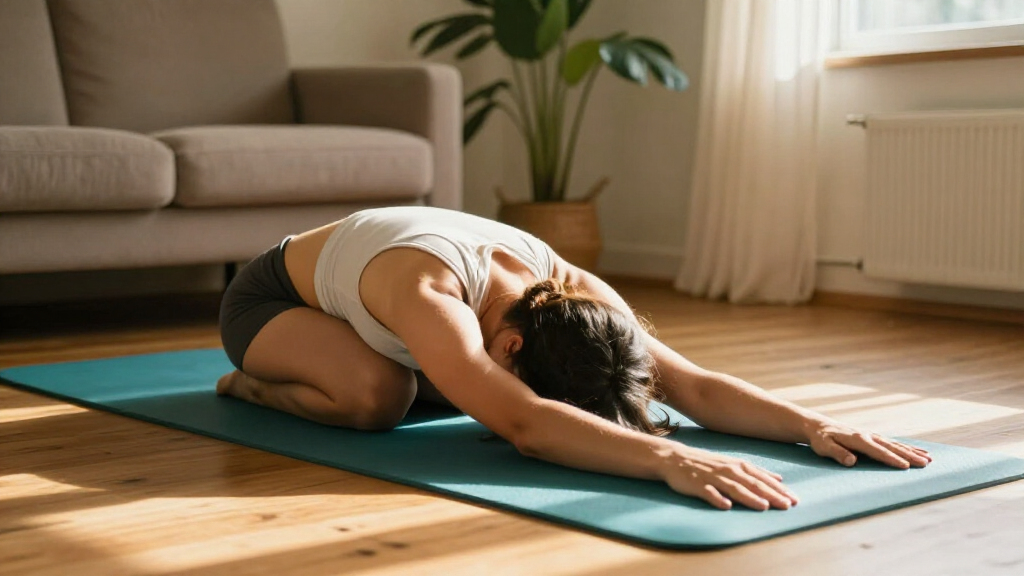
The flow begins with waterfall pose, lying on the back with the legs supported up a wall for three to five breaths. It continues with child’s pose for three to five breaths, then a ragdoll forward fold for two rounds of three to five breaths. It ends with a seated spinal twist, held for two to three breaths on each side. These are the durations and repetitions given in the Fit&Well report.
Boyett describes the sequence as a way to slow down and pay attention to the body, rather than an effort to stretch as far as possible. She says the movements may be used after a challenging workout, a run or prolonged desk work. Those are her recommendations and descriptions; the article does not present clinical testing or measurements showing that this particular flow improves flexibility or speeds recovery.
A Short Routine for Recovery Time
The report puts recovery alongside regular exercise, offering readers a short routine that can be done at home without equipment. Its four poses provide a specific starting point for people who want to add gentle movement after training or break up time spent sitting, without needing to follow an advanced class.
The distinction between a suggested routine and proven outcomes matters. Boyett says the poses may help people relax and address areas of tension, but Fit&Well does not provide evidence that the sequence prevents injury, treats pain or produces a particular flexibility gain. Readers should treat it as general movement guidance, not medical care or a guaranteed result.
Popular right now

Sony WH-1000XM6 Wireless Noise-Canceling Over-Ear Headphones, Blue, Bundle

Vitamix Propel Series 750 Professional-Grade Blender, 4 Programs, Black

Roborock Robot Vacuum and Mop with LiDAR Navigation and 10,000 Pa Suction
As an affiliate, we earn on qualifying purchases.
Four Poses, No Equipment
Boyett frames the sequence around the idea that exercise and recovery both have a place in a consistent routine. In her comments to Fit&Well, she says recovery need not mean complete inactivity and recommends approaching it deliberately. She also says that taking time to stretch and breathe can change how someone feels, though this is a personal assessment rather than a measured finding in the report.
The poses progress from a supported position on the floor to kneeling, standing and seated movement. Boyett says the combination of restorative postures, forward folding and gentle rotation is intended to avoid the need for advanced flexibility. The source gives instructions and breath counts for each movement, but does not report a formal trial, participant results or comparisons with other recovery routines.
Evidence and Individual Limits
The Fit&Well report does not specify when it was published or provide independent research measuring the flow’s effects. It is therefore unclear from the source whether the sequence has been evaluated for changes in flexibility, soreness or recovery time. Boyett’s statements about the possible benefits are attributed guidance, not reported clinical findings.
People’s comfort and mobility vary, and the report does not offer modifications for every injury or medical condition. Boyett advises anyone with an injury or relevant health condition to seek appropriate professional guidance before trying the movements. The source does not specify how often to repeat the flow or whether it is suitable for particular diagnoses.
Use Comfort as Your Guide
Readers can follow the report’s listed sequence and breath counts, keeping movements gentle and stopping if a pose causes pain. Boyett’s stated guidance is to avoid forcing a stretch and to consult a qualified professional before trying the flow when an injury or relevant medical condition is involved.
Fit&Well’s report does not announce a follow-up study, additional instruction or a planned update. Any further evidence about this specific routine’s effects, or additional adaptations for different needs, remains unreported in the source material.
Key Questions
What poses are included in the yoga flow?
The four movements are waterfall pose with the legs supported against a wall, child’s pose, a ragdoll forward fold and a seated spinal twist. Fit&Well’s report gives instructions and breath counts for each.
Does the routine require equipment or yoga experience?
Boyett describes the sequence as requiring no equipment or previous yoga experience. The waterfall pose uses a wall for support, and the report says the flow does not require advanced flexibility.
How long should each pose be held?
The report recommends three to five breaths for waterfall pose and child’s pose, two rounds of three to five breaths for the ragdoll fold, and two to three breaths per side for the seated twist. It does not give a total session time.
Is the flow proven to improve flexibility or recovery?
The source does not report clinical testing or measured results for this specific sequence. Boyett describes its intended use and possible benefits, but the report does not establish that it improves flexibility, treats pain or speeds recovery.
Who should seek advice before trying it?
Boyett advises people with an injury or relevant medical condition to seek appropriate professional guidance first. She also recommends moving slowly and not pushing through pain.
Source: fitandwell.com