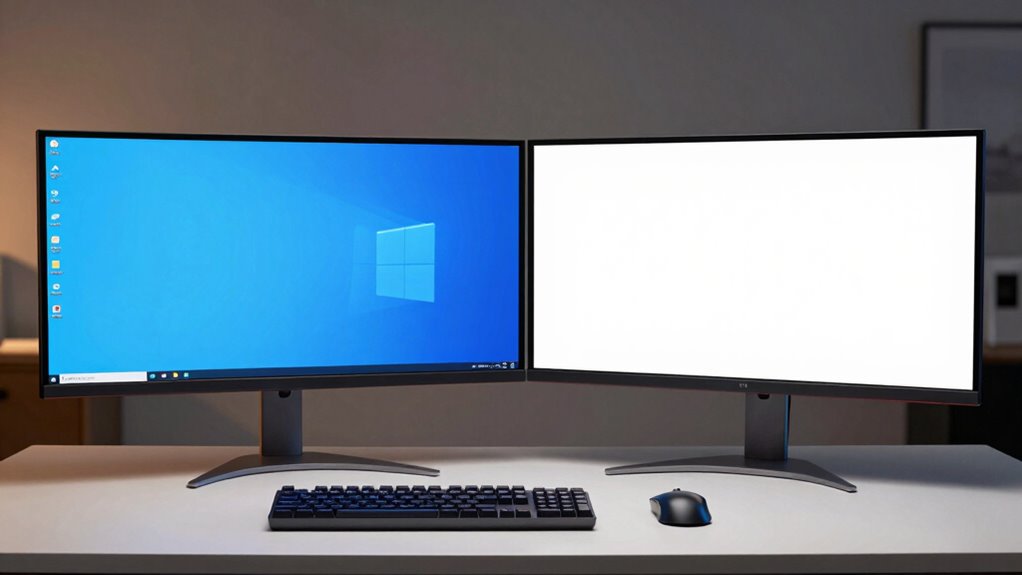

To decide between an ultrawide or dual monitors, start by evaluating your workspace to guarantee the setup fits comfortably. Think about your workflow—whether you need seamless wide views for creative tasks or separate screens for multitasking. Consider your budget and hardware capabilities, as ultrawide monitors often cost more but save space. Ergonomics and long-term costs also matter. Explore these factors further to find the ideal layout that boosts your productivity and suits your needs.
Key Takeaways
- Assess available workspace to determine if large ultrawide or dual monitors fit comfortably without clutter.
- Match monitor setup to your multitasking needs: seamless wide view versus dedicated application spaces.
- Consider ergonomic positioning and visual comfort for extended use in each configuration.
- Compare costs, upgrade flexibility, and long-term value based on initial investment and workspace requirements.
- Ensure hardware compatibility and desired layout options align with your workflow and aesthetic preferences.
Top picks for "ultrawide dual monitor"
Open Amazon search results for this keyword.
As an affiliate, we earn on qualifying purchases.
Assessing Your Workspace and Space Requirements

Before choosing between ultrawide and dual monitors, it’s essential to evaluate your workspace and space requirements. Measure your desk’s dimensions and consider available clearance around your setup. Ultrawide monitors tend to be large, often requiring more horizontal space, so confirm your desk can accommodate their width comfortably. Dual monitors, on the other hand, need sufficient depth and height to fit both screens without crowding your workspace. Think about your ergonomic comfort too—do you have enough room to position monitors at eye level? Keep in mind your movement space and whether the setup might obstruct other desk items or storage areas. By understanding your workspace limitations, you can select a monitor configuration that fits well without sacrificing comfort or functionality.
Evaluating Your Workflow and Multitasking Needs

Think about how many tasks you juggle daily and how complex they are. Are you often switching between multiple applications or working on large projects? Understanding your workflow helps you choose the right monitor setup to boost your productivity.
Assess Multitasking Complexity
Understanding your workflow and multitasking habits is essential when choosing between ultrawide and dual monitors. Consider how many tasks you juggle simultaneously and how complex they are. If you often switch between multiple applications or need to reference several documents at once, dual monitors can offer dedicated space for each task, reducing clutter. Conversely, if your work involves seamless multitasking across related apps, an ultrawide monitor provides a continuous, expansive view, making it easier to manage multiple windows without interruption. Think about your typical multitasking load: do you need quick access to many programs or a broad workspace for a few core tasks? Clarifying these needs helps you determine which setup minimizes distractions and boosts your productivity.
Identify Workspace Demands
To choose the right monitor setup, you need to assess your workspace demands by evaluating your workflow and multitasking needs. Think about how many applications you juggle daily and how often you switch between tasks. Do you need to see multiple windows side by side, or do you prefer dedicated screens for specific functions? Consider your work style—are you editing videos, designing graphics, coding, or managing spreadsheets? If your tasks require extensive multitasking, dual monitors might offer better separation. For seamless, wide views, an ultrawide could reduce window-switching and streamline your workflow. Also, evaluate your physical workspace and ergonomic comfort. Being honest about your productivity patterns helps you choose a setup that enhances efficiency without cluttering your desk or causing strain.
Comparing Visual Experience and Ergonomics
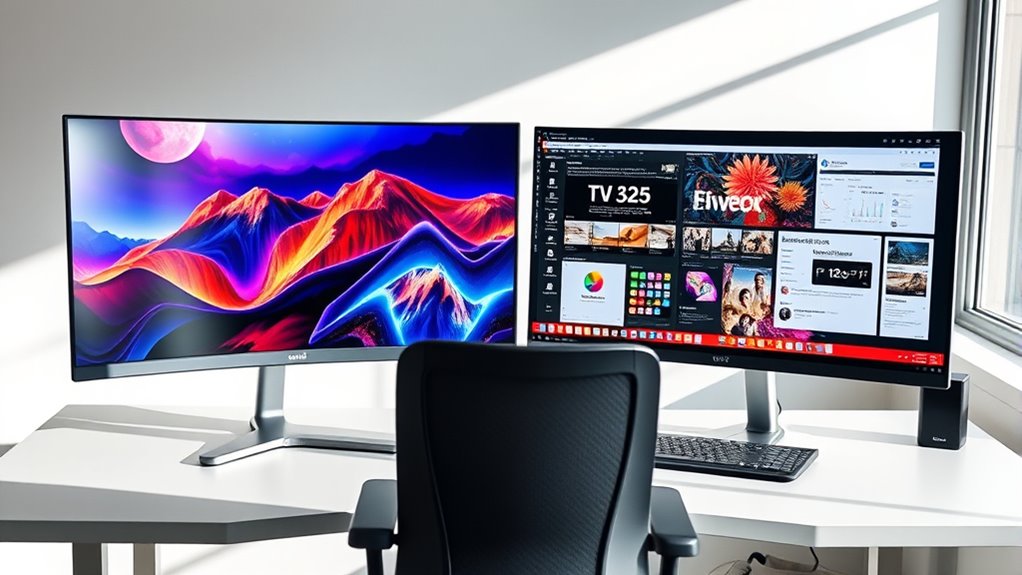
Your field of view can feel more expansive with an ultrawide monitor, reducing the need to turn your head, while dual monitors let you organize multiple screens more precisely. Ergonomics also plays a role, as ultrawides can minimize gaps and distractions, but dual setups offer flexible positioning for comfort. Considering how these differences impact your workspace will help you choose the best option for your needs.
Field of View Differences
When comparing ultrawide and dual monitors, the field of view plays a crucial role in how immersive and comfortable your setup feels. Ultrawide monitors deliver a single, continuous display that wraps around your peripheral vision, creating a seamless and immersive experience. This can enhance your focus and reduce distractions, especially in gaming or creative work. Dual monitors, on the other hand, split your field of view into two separate screens, which may cause a slight interruption in visual flow. You’ll need to turn your head or shift your gaze more often to see both screens fully. While ultrawides offer a broader, more unified view, dual monitors give you flexibility, allowing you to customize each screen for specific tasks. Your choice impacts how natural and engaging your visual experience will be.
Workspace Ergonomics Impact
While the field of view influences immersion, workspace ergonomics directly affect comfort and productivity during extended use. With an ultrawide monitor, you benefit from a seamless, curved display that reduces neck strain by minimizing head movement. This setup encourages a natural viewing angle, helping you maintain good posture. Conversely, dual monitors allow you to position screens at different angles, which can be adjusted for ideal comfort, but may cause neck or eye strain if not aligned properly. Ergonomics also involve desk space and monitor height; ultrawides require a larger setup, potentially impacting your workspace arrangement. Dual monitors offer flexibility, but managing multiple stand heights or arms might create clutter. Your choice impacts long-term comfort, so consider how each layout supports your ergonomic needs during extended work sessions.
Considering Budget and Long-Term Investment
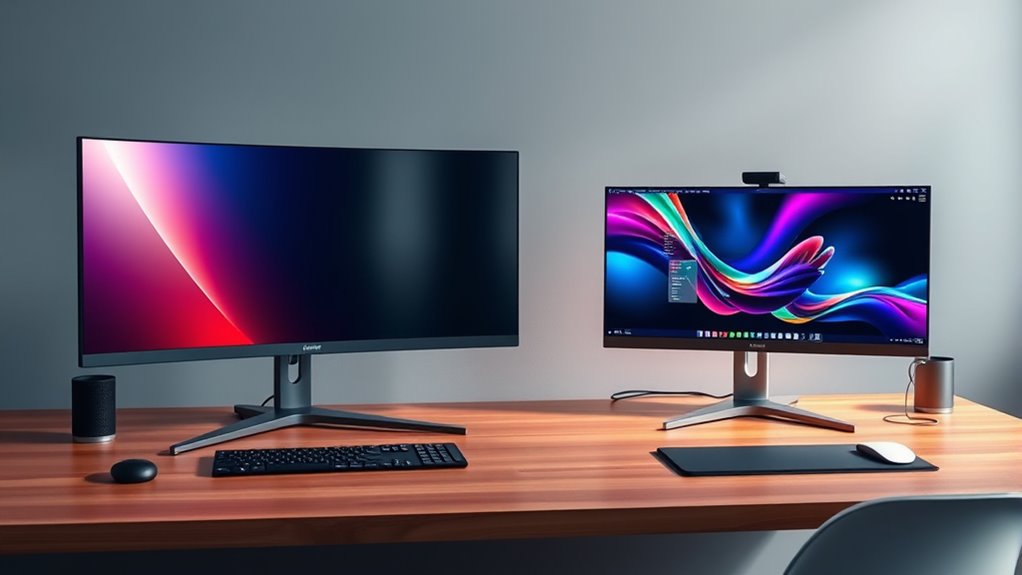
Considering budget constraints and the desire for a smart long-term investment, choosing between ultrawide and dual monitors requires careful evaluation. Ultrawide monitors typically cost more upfront but can eliminate the need for multiple screens, saving space and reducing cable clutter. Dual monitors often have a lower initial price point and offer flexibility—you can upgrade or replace one screen without affecting the other. Think about your long-term needs: will you benefit from a seamless, wide workspace, or do you prefer the ability to customize and expand your setup over time? Also, consider potential maintenance costs and future upgrades. Investing wisely now can save you money and hassle later, whether you opt for an ultrawide’s immersive experience or the modularity of dual monitors.
Analyzing Compatibility With Software and Hardware
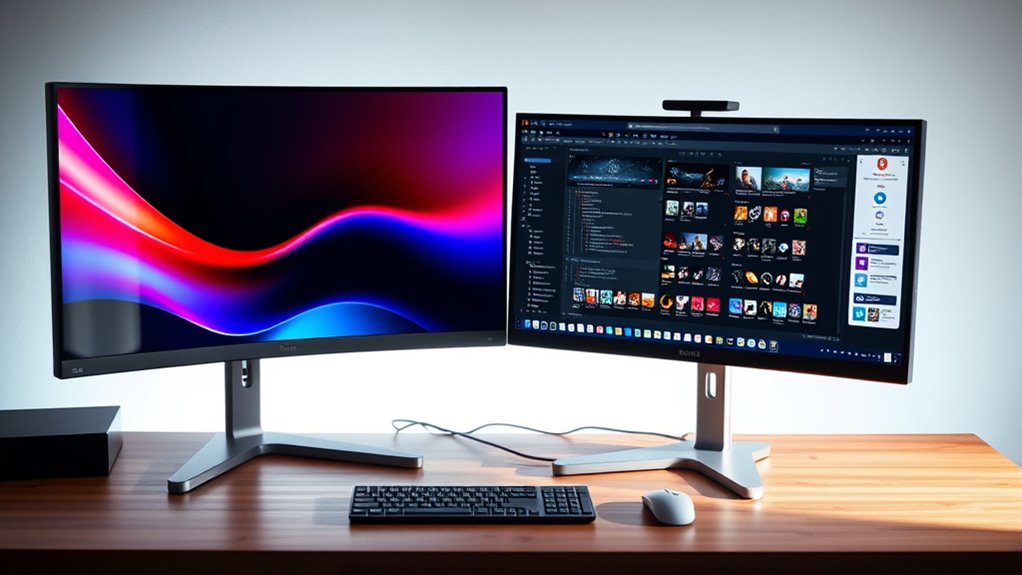
Choosing between ultrawide and dual monitors also means ensuring your setup works smoothly with your existing software and hardware. Check if your graphics card can support the resolution and size of your chosen display. Ultrawide monitors often require higher bandwidth and more powerful GPUs, especially for gaming or design work. Dual monitors may be easier to set up if your hardware has multiple video outputs. Consider software compatibility too—some applications handle multiple screens better than others. For example, video editing or CAD software might benefit more from dual displays, while immersive gaming and certain productivity tools excel on ultrawide screens. Make sure your operating system supports multi-monitor configurations seamlessly. Testing your current hardware and software compatibility prevents unexpected issues and guarantees your workspace remains efficient.
Making the Final Choice Based on Your Priorities

Your final decision should align closely with your specific needs and how you plan to use your monitors. Consider whether multitasking, gaming, or creative work is your priority. If you need seamless workflows, an ultrawide might suit you best. If you prefer dedicated screens for different tasks, dual monitors could be ideal. To visualize, think of this table:
| Priority | Preferred Setup |
|---|---|
| Multitasking | Dual monitors |
| Creative work | Ultrawide for continuity |
| Gaming | Ultrawide for immersion |
| Space constraints | Dual monitors for flexibility |
| Budget | Dual monitors typically cost less |
Match your priorities to these factors to make a confident choice that enhances your productivity and experience.
Frequently Asked Questions
How Do Ultrawide and Dual Monitors Affect Eye Strain and Long-Term Vision Health?
Ultrawide and dual monitors can both impact your eye strain and long-term vision health. Ultrawide screens reduce the need to shift your gaze frequently, potentially decreasing strain, but their larger size may cause you to lean forward or adjust posture. Dual monitors encourage more movement, but inconsistent angles and bezels can lead to discomfort. To protect your eyes, take regular breaks, maintain proper distance, and adjust brightness and contrast settings.
Can I Upgrade or Expand My Monitor Setup Easily Later?
Think of your monitor setup as a garden—you can add more plants over time. Upgrading or expanding your setup is usually straightforward if you choose compatible monitors and ports. With ultrawide monitors, upgrading might mean replacing the whole plant, while dual monitors let you add more plants easily. Just check your computer’s connections and space, and you’re ready to grow your workspace as your needs evolve.
What Are the Common Connectivity Issues With Ultrawide Versus Dual Monitors?
You might face connectivity issues with ultrawide monitors if your graphics card has limited ports or outdated drivers, leading to display problems or flickering. With dual monitors, you could encounter compatibility issues between different models or resolutions, causing misalignment or resolution mismatches. Both setups may experience bandwidth limitations if your cables or ports aren’t high quality. To avoid these issues, verify your hardware supports your desired configuration and keep drivers updated.
How Do Monitor Sizes Influence Desk Space and Overall Aesthetics?
Monitor sizes substantially impact your desk space and overall aesthetics. Larger screens, like ultrawides, create a sleek, seamless look but may dominate your desk, leaving less room for other essentials. Smaller monitors are more compact, freeing up space and offering a balanced appearance. Consider your workspace size and style preference to choose a monitor that enhances both functionality and visual harmony, without cluttering or overwhelming your setup.
Are There Specific Tasks or Industries That Benefit More From One Setup?
Imagine you’re a skilled pilot steering through thick fog. For complex tasks like video editing, programming, or financial trading, an ultrawide monitor acts like a panoramic windshield, offering seamless, continuous views that keep everything in sight. If you juggle multiple applications or need separate screens for different tasks—akin to having multiple control towers—dual monitors provide focused, dedicated spaces. Your industry determines which setup guides your flight path.
Conclusion
Ultimately, choosing between ultrawide and dual monitors is like picking the right tool for your crafts—each has its own rhythm and flow. Think about your space, workflow, and budget, and let your priorities guide you. When you align your needs with the right setup, your workspace transforms into a well-tuned orchestra, harmonizing productivity and comfort. Trust your instincts, and you’ll find the perfect monitor arrangement to elevate your work and play.