TL;DR

Get comfort and recovery gear delivered free with Prime
- Fast, free delivery on millions of items
- Prime Video, Amazon Music and more included
- Member-only deals all year
An ergonomic office chair is designed to support the body while allowing posture changes throughout the day — and adjustability matters more than brand, price, or material. No chair fits everyone, no chair cures back pain, and even a perfect chair can’t compensate for a badly positioned monitor or keyboard. Focus on fit (seat height, depth, lumbar support), movement, and a trial period before you commit.
You could spend $1,800 on a chair and still end up with a stiff back by Thursday. Meanwhile, your colleague swears by a $250 model from a home-office brand. That’s not bad luck — it’s fit. An ergonomic office chair is designed to support the body while allowing posture changes throughout the day, and whether it supports your body depends on measurements, not the price tag.
Here’s the uncomfortable truth the industry won’t shout about: there is no universally perfect chair. Body dimensions, work habits, and even your desk height change the equation entirely.
In this guide, you’ll learn which features actually matter, how to adjust your chair properly in 10 steps, and the buying checklist that saves you from an expensive mistake. No hype. Just fit.
Adjustability beats price and brand — verify seat-height and seat-depth ranges against your body before anything else.
Movement matters more than perfect posture; alternate between supported positions and take breaks before discomfort starts, not after.
A modest 100–110 degree recline reduces spinal loading compared to rigid upright sitting — use your backrest.
Material (mesh, fabric, leather) affects comfort and durability, not ergonomics; foam quality is the sleeper factor.
Insist on a home trial period of several working days — showroom comfort doesn’t predict day-three comfort.
The 5 Adjustments That Separate Real Ergonomic Chairs From Fancy Dinette Chairs
Ergonomic office chairs earn the label through adjustment range — not mesh, not leather, not a sleek showroom silhouette. If a chair can’t be tuned to your body, it’s just furniture. Here are the five adjustments that do the heavy lifting.
Seat height: Your feet rest flat on the floor (or a footrest), knees level with or slightly below your hips. If you’re 5’2″ and a chair’s minimum height leaves your feet dangling, walk away — no feature list fixes that.
Seat depth: Sit all the way back against the backrest. You want roughly two to three finger-widths between the seat edge and the backs of your knees. A seat that’s too deep cuts circulation; too shallow and you lose thigh support.
Lumbar support: It should land in the inward curve of your lower back. Adjustable height and depth beat fixed pads, because spinal curves differ — sometimes a lot.
Recline and tension: A backrest that reclines with adjustable resistance lets you shift positions without fighting the chair. That matters more than you think — more on that below.
Armrests: Height, width, depth, and pivot. They should support your forearms without lifting your shoulders or forcing elbows outward. Poorly positioned armrests are worse than none.
More adjustments only help when they fit you. A highly adjustable chair can still be wrong for you if its seat pan is too deep or its minimum height is too high.
ergonomic office chair with adjustable seat height
As an affiliate, we earn on qualifying purchases.
As an affiliate, we earn on qualifying purchases.
Why Your Perfectly Upright Posture Is Quietly Wearing You Out
Sitting bolt upright all day is not the gold standard — that honor belongs to movement. No seated position stays comfortable indefinitely, and research on workstation ergonomics consistently shows that changing position regularly beats holding any single “correct” posture [3].
A modest recline — think 100 to 110 degrees instead of a rigid 90 — can actually reduce muscular effort and spinal loading. Your backrest isn’t a decoration; it’s supposed to carry some of your weight.
Picture the typical workday: you start the morning sitting tall, and by 2 p.m. you’ve melted into a slouch. That’s not laziness — that’s your muscles asking for a different load. A reclining backrest with adjustable tension gives you supported positions to rotate through instead of two bad options.
So the real question isn’t “what’s the healthiest sitting position?” It’s “how often do you change yours?” Practical approach: shift position and take brief movement breaks before discomfort develops, not after. Standing all day isn’t the fix either — you’d just trade one static posture for another.
ergonomic desk chair with lumbar support
As an affiliate, we earn on qualifying purchases.
As an affiliate, we earn on qualifying purchases.
Mesh vs. Fabric vs. Leather: A Quick Honest Comparison
Material choice is mostly about comfort, climate, and maintenance — not ergonomics itself. A well-designed mesh back and a quality fabric back can support you equally well. Here’s how they stack up.
| Material | Strengths | Watch Out For |
|---|---|---|
| Mesh | Breathable, conforms to the body, stays cool in summer | Poorly designed edges can create pressure points |
| Fabric | Consistent grip and cushioning, huge texture range | Harder to clean, can trap heat |
| Leather / synthetic | Easy to wipe clean, formal look | Retains heat; cheap synthetics peel within a few years |
One sleeper factor: foam quality. Very soft padding feels dreamy in a 5-minute showroom test, then compresses and loses support within months. A moderately firm seat that distributes pressure without bottoming out usually wins the long game.
And skip the headrest debate unless you actually recline — headrests are optional for upright computer work. They earn their keep only if they support your head without pushing it forward during leaned-back tasks.
As an affiliate, we earn on qualifying purchases.
How to Adjust Your Chair in 10 Steps (Do This Today)
Even a great ergonomic office chair performs poorly when it’s set up wrong. Follow this order — it takes about five minutes and works whether your chair cost $200 or $2,000.
- Set seat height so feet are supported and thighs are comfortable.
- Adjust seat depth to avoid pressure behind the knees.
- Position lumbar support in your lower-back curve.
- Set recline tension so leaning back feels controlled, not like a wrestling match.
- Place armrests under relaxed forearms without raising your shoulders.
- Sit close to the desk so you’re not reaching forward.
- Put the keyboard and mouse around elbow height.
- Position the monitor directly ahead, upper edge near eye level.
- Reassess after 20–30 minutes of actual work — initial comfort lies.
- Change position and take movement breaks regularly.
That last step is the one everyone skips. Don’t be everyone.
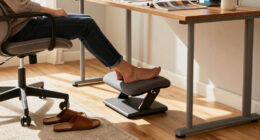
If lowering your chair for proper foot contact makes your desk feel too high, you need a footrest, an adjustable desk, or a keyboard tray — not a compromise on either.
office chair with adjustable recline and tension
As an affiliate, we earn on qualifying purchases.
As an affiliate, we earn on qualifying purchases.
What to Check Before You Buy: The Checklist That Saves Regret
Buying an ergonomic chair online is a calculated bet — you can win it if you verify the right numbers first. “Ergonomic” isn’t a tightly controlled term, so the label proves nothing. Compare the chair’s measurement ranges against your body and desk, and favor sellers offering a real home trial.
- Seat-height and seat-depth ranges (the two most common fit failures)
- Lumbar-support position and adjustability
- Recline type, range, lock positions, and tension
- Armrest adjustment range
- Seat width and tested weight capacity — with a safety margin
- Caster compatibility with your flooring (hard wheels for carpet, soft for hardwood)
- Certifications like ANSI/BIFMA (North America) or EN 1335 (Europe) — evidence of tested strength, stability, and safety [4]
- Replacement parts and warranty exclusions
- Return shipping and restocking costs — read the fine print
Real-world example: a used premium chair can outlast a new budget chair, but only if the gas cylinder, mechanism, and upholstery check out — and only if replacement parts are still available. Some brands run 12-year warranties with modular parts, which changes the total-ownership math dramatically.
Short or tall? Shorter users should scrutinize minimum seat height and depth. Taller users need maximum height, deeper pans, and taller backrests. And a footrest does not fix a seat that’s too deep.
The One Thing a Chair Can’t Do (That Sales Pages Won’t Tell You)
No ergonomic chair — at any price — diagnoses, treats, or cures back pain. Research generally supports combining suitable equipment with training, workstation adjustments, and regular movement; evidence that a chair alone prevents or fixes back pain is limited [2]. A chair may ease discomfort caused by poor support, but it’s not medicine.
It also can’t rescue a broken workstation. Even a perfectly fitted chair loses to a monitor six inches too low or a keyboard that forces you to reach. Your chair is one piece of a system that includes screen height, viewing distance, lighting, and break habits.
If you have persistent, severe, or radiating pain, see a qualified healthcare professional before you blame — or credit — your furniture.
That’s also why trial periods are gold. A five-minute showroom sit tells you almost nothing. Comfort on day three, after your body has settled into its real patterns? That’s the signal worth paying for.
Frequently Asked Questions
Are ergonomic office chairs worth the money?
They can be, especially if you sit for long stretches — better fit, durability, and warranty support justify the cost. But price alone doesn’t determine ergonomic quality; a mid-priced chair with the right adjustment ranges can outperform a premium one that doesn’t fit you.
Can an ergonomic chair fix back pain?
It may reduce discomfort caused by poor support or bad workstation fit, but it can’t diagnose or cure an underlying condition. Persistent, severe, or radiating pain should be assessed by a qualified healthcare professional — not treated with furniture.
What is the healthiest sitting position?
There isn’t one. A supported posture with relaxed shoulders, supported feet, and minimal reaching is a good starting point — but frequent position changes are what actually matter. Recline a little, sit upright, stand, walk. Rotate.
Should my knees be at exactly 90 degrees?
Not necessarily. Ninety degrees is a rough approximation, not a rule. Comfort, fully supported feet, uncompressed thighs, and hips at or slightly above knee level matter more than hitting an exact angle.
Can gaming chairs be ergonomic?
Some are adjustable and supportive, but the category often prioritizes styling, side bolsters, and thick padding over precise fit. Judge them with the same criteria as office chairs: seat-height range, depth, lumbar position, and armrest adjustability.
Conclusion
The best ergonomic office chair is the one that fits your body, supports several positions, plays nicely with your desk and monitor, and makes movement easy. Everything else — the mesh, the badge, the four-dimensional armrests — is negotiable.
So before you click “buy” on that sleek showroom star, grab a tape measure and your desk height. Your future back, the one that isn’t aching at 3 p.m., will thank you.
Columbus Day / Indigenous Peoples' Day Picks
long weekend sales
As an affiliate, we earn on qualifying purchases.