
Complete the kit


Get comfort and recovery gear delivered free with Prime
- Fast, free delivery on millions of items
- Prime Video, Amazon Music and more included
- Member-only deals all year
Key Takeaways
- mmWave radar sensors like the SwitchBot are superior for desk environments because they detect breathing and micro-movements, preventing lights from turning off during static work.
- Dual-technology sensors (PIR + Ultrasonic) are the industry standard for open-plan offices because the dual verification reduces false triggers from air currents or HVAC systems.
- Hardwired ceiling sensors generally offer more consistent coverage for large rooms but require professional installation, whereas plug-in or battery-operated units suit retrofit projects and leased spaces.
- Pet-friendly modes are largely irrelevant in professional office settings but become critical if the space doubles as a home office or shared living area.
- Ambient light sensing is a hidden efficiency feature; sensors that only trigger when the room is dark save significantly more energy in offices with large windows.
| Ring Motion Detector with Pet-Friendly Mode |  | Best for Pet-Friendly Small Offices | Motion detection range: 30 ft. | Field of view: 90° | Connectivity: Amazon Sidewalk or Z-Wave; Z-Wave requires an alarm base station | VIEW LATEST PRICE | See Our Full Breakdown |
| SwitchBot Smart mmWave Radar Presence Sensor, 2-Pack |  | Best for Presence-Aware Automations | Pack size: 2 sensors | Sensor technologies: 60 GHz mmWave radar, PIR, and light sensing | Detection range: Up to 8 m moving; up to 5 m stationary | VIEW LATEST PRICE | See Our Full Breakdown |
| ENERLITES Dual-Technology Ultrasonic and PIR Ceiling Occupancy Sensor, MDC-50V-W | 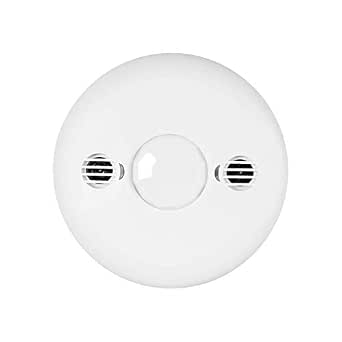 | Best for Fine-Movement Detection | Sensor technologies: Ultrasonic and passive infrared (PIR) | PIR coverage: Up to 1,600 sq ft | Ultrasonic coverage: Up to 1,000 sq ft | VIEW LATEST PRICE | See Our Full Breakdown |
| OMNI Low Voltage Ultrasonic and PIR Ceiling Sensor |  | Best for Large Commercial Offices | Sensing technology: Ultrasonic and passive infrared (PIR) | Coverage: Up to 2,000 sq ft, 360° | Mounting: Ceiling mount; recommended height 8–12 feet | VIEW LATEST PRICE | See Our Full Breakdown |
| AH Lighting 360° Ceiling Occupancy Motion Sensor, Hardwired PIR, Adjustable Settings, White, 5 Pack |  | Best for Multi-Room Lighting Upgrades | Pack quantity: 5 sensors | Detection coverage: 360° | Maximum range: 15 feet | VIEW LATEST PRICE | See Our Full Breakdown |
| Lithonia Lighting CM PDT 10 R Ceiling-Mount 360-Degree Occupancy Sensor |  | Best for Broad Ceiling Coverage | Sensor type: Passive infrared with dual technology | Detection angle: 360 degrees | Maximum range: 28 feet | VIEW LATEST PRICE | See Our Full Breakdown |
| Akamatis HPS v4PL Dual-Sensor Presence and Motion Detector with Ambient Light Sensor |  | Best for Home Assistant Offices | Sensors: 24 GHz mmWave radar, quad-element PIR, and LTR329 ambient light sensor | Maximum range: 20 feet (6 m) | PIR field of view: 120 degrees | VIEW LATEST PRICE | See Our Full Breakdown |
| Leviton Decora PIR Wall Switch Occupancy Sensor, ODS06-IDW, White |  | Best Wall-Switch Retrofit | Sensor type: Passive infrared (PIR) | Switch type: Single-pole | Field of view: 180 degrees | VIEW LATEST PRICE | See Our Full Breakdown |
| motion sensors for office | Mounting | Power | Dimensions | Maximum range |
|---|---|---|---|---|
| Ring Motion Detector with Pet- | — | 2 included AA alkaline batteries | 2.60 x 2.60 x 1.57 inches | — |
| SwitchBot Smart mmWave Radar P | Magnetic base; flat placement or wall mount | 2 AAA batteries required | 2.1 × 1.2 × 2.1 inches | — |
| ENERLITES Dual-Technology Ultr | Ceiling mount; recommended height 8–10 feet | Corded electric | — | — |
| OMNI Low Voltage Ultrasonic an | Ceiling mount; recommended height 8–12 feet | DC; universal voltage power pack required separately | — | 8 feet |
| AH Lighting 360° Ceiling Occup | Ceiling mount; recommended height 10–15 feet | — | — | 15 feet |
| Lithonia Lighting CM PDT 10 R | Ceiling mount | — | 4.55 × 4.55 × 1.55 inches | 28 feet |
| Akamatis HPS v4PL Dual-Sensor | Wall mount with adjustable two-axis mount | — | 0.71 × 1.26 × 2.32 inches | 20 feet (6 m) |
| Leviton Decora PIR Wall Switch | Wall switch; fits a standard wallbox | — | — | — |
More Details on Our Top Picks
Ring Motion Detector with Pet-Friendly Mode
For a small office that needs straightforward room coverage without a dedicated alarm base station, I’d put the Ring Motion Detector ahead of hardwired ceiling options such as the ENERLITES MDC-50V-W. Its 30-foot range and 90-degree view suit a single room, while pet-friendly settings can cut alerts from animals under 50 pounds. Amazon Sidewalk connectivity avoids a separate base station, though coverage depends on having a nearby Sidewalk Gateway. This is a simpler alert-focused choice than the SwitchBot presence sensors, which can detect stationary people and support broader automation. The Ring’s tradeoff is that it offers less nuanced occupancy sensing, and Z-Wave use still requires an alarm base station. Battery life is rated up to two years, but activity and connectivity affect it.
Pros:- 30-foot detection range suits coverage of a typical office room.
- Pet-friendly settings can reduce alerts from animals under 50 pounds.
- Amazon Sidewalk connection works without a dedicated base station where coverage is available.
- Includes two AA batteries with a rated life of up to two years.
Cons:- Sidewalk availability varies by location and depends on gateway proximity.
- Z-Wave connectivity requires a compatible alarm base station.
- Battery life varies with activity and connectivity.
Best for: Small offices that want room-level motion alerts, have pets under 50 pounds, and can use Amazon Sidewalk coverage.
Not ideal for: Large or open-plan offices needing fine-motion or stationary-presence detection, or sites without reliable Sidewalk coverage that do not have a Ring alarm base station.
- Motion detection range:30 ft.
- Field of view:90°
- Connectivity:Amazon Sidewalk or Z-Wave; Z-Wave requires an alarm base station
- Power:2 included AA alkaline batteries
- Approximate battery life:Up to 2 years, depending on usage and connectivity
- Dimensions:2.60 x 2.60 x 1.57 inches
- Operating temperature:32°F to 120°F
- Certifications:UL, FCC
Our verdict“Choose Ring for simple, pet-aware motion alerts in a smaller office with dependable Sidewalk coverage.”
SwitchBot Smart mmWave Radar Presence Sensor, 2-Pack
The SwitchBot pair is the strongest fit here when an office needs to know someone is still at a desk, not just that they crossed a sensor’s path. Its 60 GHz mmWave radar plus PIR can detect moving and stationary people, while light sensing can inform automations. That gives it an edge over the Ring Motion Detector for desk-level occupancy routines, and its magnetic bases allow adjustable placement without committing to ceiling wiring. AI filtering is intended to reduce interference from fans and air conditioners. The tradeoff is platform complexity: Apple Home needs a SwitchBot Matter Hub, and some integrations depend on a hub. Battery-life information also differs between the description and specifications, which list up to two years and an average of three years. Buyers should plan around placement and ecosystem compatibility, not assume every integration works directly.
Pros:- mmWave radar and PIR detect stationary as well as moving people.
- Two-sensor pack can cover more than one office area.
- Magnetic bases support flat placement, wall mounting, and angle adjustment.
- AI filtering is designed to reduce interference from fans and air conditioners.
Cons:- Apple Home integration requires a SwitchBot Matter Hub.
- Some smart-home integrations depend on additional SwitchBot hardware.
- The listed battery-life estimates conflict: the description says up to two years, while the specifications list an average of three.
Best for: Small offices or shared work areas using SwitchBot devices that need desk-presence detection and flexible, non-wired placement.
Not ideal for: Offices that require direct Apple Home integration without a Matter Hub, or buyers who want a simple hardwired occupancy sensor for automatic lighting.
- Pack size:2 sensors
- Sensor technologies:60 GHz mmWave radar, PIR, and light sensing
- Detection range:Up to 8 m moving; up to 5 m stationary
- Detection angle:120°
- Mounting:Magnetic base; flat placement or wall mount
- Power:2 AAA batteries required
- Compatibility:SwitchBot devices, Apple Home, Home Assistant, Alexa, and Google Home; some integrations require a SwitchBot Matter Hub
- Dimensions:2.1 × 1.2 × 2.1 inches
Our verdict“Pick the SwitchBot pair when desk presence and flexible smart-home automations matter more than plug-and-play simplicity.”
ENERLITES Dual-Technology Ultrasonic and PIR Ceiling Occupancy Sensor, MDC-50V-W
For an office where people stay seated for long stretches, the ENERLITES MDC-50V-W offers a more suitable approach than the AH Lighting OS2301, which uses PIR alone. Its ultrasonic and PIR combination can pick up fine movements such as typing or turning pages, reducing the chance that lights go off while someone is working quietly. Six trigger modes and a 5-second-to-30-minute delay give facilities teams room to tune behavior for different rooms. Coverage is listed up to 1,600 square feet for PIR and 1,000 square feet for ultrasonic sensing, making it a wired ceiling choice rather than a quick wireless add-on like Ring. The tradeoff is installation: it needs ceiling mounting at 8–10 feet, and compatibility is limited to certain lights and the specified ENERLITES momentary switch.
Pros:- Ultrasonic and PIR sensing can detect small movements such as typing.
- Six trigger modes allow different sensing combinations.
- Adjustable time delay spans 5 seconds to 30 minutes.
- Large stated coverage makes it better suited to office spaces than Ring’s room-level 30-foot sensor.
Cons:- Requires ceiling installation at a recommended height of 8–10 feet.
- Compatibility is limited to certain lights and the specified ENERLITES momentary switch.
- Corded-electric installation is less flexible than battery-powered options such as SwitchBot.
Best for: Facilities teams fitting a wired office ceiling sensor where seated staff make small movements and adjustable occupancy timing is useful.
Not ideal for: Tenants seeking a portable sensor, offices without suitable ceiling wiring, or sites whose lighting controls fall outside the stated compatibility.
- Sensor technologies:Ultrasonic and passive infrared (PIR)
- PIR coverage:Up to 1,600 sq ft
- Ultrasonic coverage:Up to 1,000 sq ft
- Field of view:360°
- Trigger modes:6
- Time delay:Adjustable from 5 seconds to 30 minutes via DIP switch
- Mounting:Ceiling mount; recommended height 8–10 feet
- Power:Corded electric
- Compliance:UL/CUL listed; California Title 20 and 24 compliant
Our verdict“Choose the ENERLITES sensor for wired offices where fine movement detection matters more than easy installation.”
OMNI Low Voltage Ultrasonic and PIR Ceiling Sensor
The OMNI is my pick for larger offices already being fitted with a low-voltage control system. It combines ultrasonic and PIR sensing across 360 degrees and lists coverage up to 2,000 square feet, exceeding the stated area of the ENERLITES MDC-50V-W. Its IntelliDAPT self-adjusting feature is intended to limit false-on and false-off behavior, while support for linking up to four sensors can extend coverage across a larger floor. Optional relay and photocell controls also make it more adaptable to building systems than the battery-powered Ring detector. That capability comes with an installation cost in effort: it needs a separately purchased universal voltage power pack and should be mounted 8–12 feet high. It is indoor-only, so it is not a flexible choice for temporary layouts or outdoor approaches.
Pros:- Dual ultrasonic and PIR sensing provides 360-degree coverage.
- Listed coverage of up to 2,000 square feet suits larger offices.
- Self-adjusting technology is designed to reduce false-on and false-off triggers.
- Supports linking up to four sensors for expanded coverage.
Cons:- Universal voltage power pack is required and sold separately.
- Indoor use only limits placement options.
- Recommended mounting height is restricted to 8–12 feet.
Best for: Commercial facilities teams installing occupancy controls across large indoor offices with low-voltage infrastructure.
Not ideal for: Small offices wanting a self-contained wireless sensor, or buyers who need a complete kit without a separately purchased power pack.
- Sensing technology:Ultrasonic and passive infrared (PIR)
- Coverage:Up to 2,000 sq ft, 360°
- Mounting:Ceiling mount; recommended height 8–12 feet
- Power:DC; universal voltage power pack required separately
- Maximum range:8 feet
- Controls:Two timer modes; optional relay and photocell control
- Compatible systems:Light, air conditioning, and fire alarm
- Material:High-impact injection-molded polymer
- Warranty:5-year limited warranty
Our verdict“Choose OMNI for broad, integrated occupancy coverage in a large indoor office with the required power infrastructure.”
AH Lighting 360° Ceiling Occupancy Motion Sensor, Hardwired PIR, Adjustable Settings, White, 5 Pack
For an office refresh covering several rooms, the AH Lighting five-pack makes more sense than buying one-off sensors such as Ring’s detector. Each unit uses hardwired PIR detection with a 360-degree ceiling view and a 15-foot maximum range, and adjustable sensitivity, light level, and shut-off delay let installers tune lighting behavior by room. It can control connected lights or fans, making it a direct fit for automatic room controls rather than SwitchBot’s presence-focused smart-home routines. The main limitation is sensing technology: unlike the dual-tech ENERLITES and OMNI models, this PIR-only design is less suited to reliably noticing very small movements from a seated worker. Installation also requires hardwiring and a neutral wire, with a recommended mounting height of 10–15 feet.
Pros:- Five sensors support a multi-room lighting project in one purchase.
- 360-degree ceiling detection covers movement across a room.
- Sensitivity, light-level activation, and shut-off delay are adjustable.
- Can control connected lights and fans; UL/cUL listed and California Title 24 compliant.
Cons:- Hardwired installation requires a neutral wire.
- PIR-only sensing is less suited than the ENERLITES dual-tech sensor to detecting subtle seated movement.
- Recommended mounting height of 10–15 feet may not suit every office ceiling.
Best for: Office managers or electricians upgrading lighting controls across several rooms with compatible wiring and neutral wires available.
Not ideal for: Leased offices that cannot modify wiring, locations without a neutral wire, or quiet workspaces where fine-motion detection is a priority.
- Pack quantity:5 sensors
- Detection coverage:360°
- Maximum range:15 feet
- Mounting:Ceiling mount; recommended height 10–15 feet
- Sensor technology:PIR
- Power and wiring:Corded electric; hardwired, neutral wire required
- Adjustable settings:Sensitivity, light level, and time delay
- Compatible loads:Lights and fans
- Compliance:UL/cUL listed; California Title 24 compliant
Our verdict“Choose the AH Lighting five-pack for wired, multi-room light or fan control when fine-motion sensing is not the main requirement.”
Lithonia Lighting CM PDT 10 R Ceiling-Mount 360-Degree Occupancy Sensor
I’d choose the Lithonia CM PDT 10 R for an office room where a ceiling-mounted sensor needs to monitor movement across a broad area. Its 360-degree field of view and stated 28-foot maximum range suit classrooms, meeting rooms, and other spaces where a wall switch sensor may leave parts of the room outside its view. Dual-technology sensing is intended to help detect movement behind obstructions, though its passive-infrared component still needs a clear line of sight. Compared with the Leviton Decora ODS06-IDW, this is the better fit for overhead coverage rather than replacing a wall switch. The tradeoff is installation flexibility: it is designed for ceiling mounting and requires a suitable power connection, so it is less convenient for a simple retrofit.
Pros:- 360-degree ceiling coverage monitors movement from all directions below the sensor.
- Maximum stated detection range of 28 feet suits larger rooms.
- Dual-technology sensing is designed to improve detection around obstructions.
- Matte white housing blends into many classroom and office ceilings.
Cons:- Passive infrared sensing requires a clear line of sight, limiting placement behind obstructions.
- Ceiling-mount design offers fewer placement options than a wall-switch sensor.
- Installation requires a compatible power connection rather than a standalone battery setup.
Best for: Facilities teams fitting out classrooms, meeting rooms, or larger office areas that can support ceiling-mounted, hardwired sensors.
Not ideal for: Office managers seeking a quick wall-switch replacement or anyone who cannot provide a clear detection path and ceiling power connection.
- Sensor type:Passive infrared with dual technology
- Detection angle:360 degrees
- Maximum range:28 feet
- Mounting:Ceiling mount
- Power source:Corded electric
- Relay:Isolated low-voltage relay
- Dimensions:4.55 × 4.55 × 1.55 inches
Our verdict“Choose this Lithonia model for broad overhead coverage in a larger office or classroom, but skip it if you need an easy wall-switch retrofit.”
Akamatis HPS v4PL Dual-Sensor Presence and Motion Detector with Ambient Light Sensor
The Akamatis HPS v4PL is the most automation-focused option here: its 24 GHz mmWave radar works alongside quad-element PIR, while an ambient light sensor can help a Home Assistant setup respond to both occupancy and brightness. Adjustable sensitivity and a two-axis mount let an integrator tune the detection zone instead of relying on a fixed ceiling pattern. Compared with the Lithonia CM PDT 10 R, this compact wall-mounted unit offers more direct smart-home customization, but its listed range is shorter at 20 feet and it is not a self-contained lighting switch. It also depends on an existing Home Assistant installation, and the required USB-C power cable is not included. I’d skip it for offices that need conventional standalone occupancy control.
Pros:- Combines mmWave presence detection with quad-element PIR motion sensing.
- Ambient light readings support brightness-aware office automations.
- Adjustable sensitivity and two-axis mounting help tailor coverage.
- Pre-flashed ESPHome firmware can be customized within a Home Assistant setup.
Cons:- Requires an existing Home Assistant installation and configuration.
- USB-C power cable is not included.
- Maximum stated range is 20 feet, shorter than the Lithonia ceiling sensor’s 28-foot range.
Best for: Small-office owners or automation integrators already running Home Assistant who want adjustable presence and ambient-light triggers.
Not ideal for: Facilities teams seeking a standalone lighting sensor, a plug-and-play system without Home Assistant, or a complete kit with its power cable included.
- Sensors:24 GHz mmWave radar, quad-element PIR, and LTR329 ambient light sensor
- Maximum range:20 feet (6 m)
- PIR field of view:120 degrees
- Power source:5 V USB-C; cable not included
- Mounting:Wall mount with adjustable two-axis mount
- Compatibility:Home Assistant
- Firmware:Pre-flashed Akamatis ESPHome
- Dimensions:0.71 × 1.26 × 2.32 inches
Our verdict“Pick the Akamatis for a Home Assistant office that needs customizable presence and light automations, not as a standalone lighting control.”
Leviton Decora PIR Wall Switch Occupancy Sensor, ODS06-IDW, White
For offices where the goal is to replace a conventional switch, I’d favor the Leviton Decora ODS06-IDW over the ceiling-mounted Lithonia sensor. It fits a standard wallbox, offers manual push-button control, and its PIR coverage is listed at approximately 1,600 square feet, making it a practical choice for a compatible single-pole circuit. High-inrush stability circuitry is designed for LED loads, which can help avoid problems when controlling office lighting. The tradeoff is that its 180-degree field of view depends on wall placement; it does not provide the overhead, all-around coverage of Lithonia’s 360-degree unit or the configurable smart-home automations of the Akamatis HPS v4PL. It is also intended for single-pole use, so it won’t suit every switch arrangement, and its IP20 rating limits it to indoor settings.
Pros:- Fits a standard wallbox as a replacement for a single-pole switch.
- 180-degree field of view and approximately 1,600-square-foot stated coverage suit many office layouts.
- High-inrush stability circuitry is designed for LED loads.
- Push-button control and adjustable delay from 30 seconds to 30 minutes give occupants manual control.
Cons:- Single-pole design limits compatibility with multiway switch arrangements.
- Wall placement provides narrower directional coverage than the Lithonia sensor’s 360-degree ceiling view.
- IP20 protection is intended for indoor use, not damp or exposed locations.
Best for: Office electricians or property managers replacing a compatible single-pole wall switch with occupancy-based lighting control and manual override.
Not ideal for: Buyers needing a ceiling-mounted 360-degree sensor, Home Assistant presence automation, or a control for a multiway switch circuit.
- Sensor type:Passive infrared (PIR)
- Switch type:Single-pole
- Field of view:180 degrees
- Coverage:Approximately 1,600 sq. ft.
- Operating voltage:277 V AC
- Wattage:600 W
- Delay:30 seconds to 30 minutes
- Mounting:Wall switch; fits a standard wallbox
- Certifications:CEC Title 24 Compliant, RoHS, UL
Our verdict“Choose the Leviton for a compatible single-pole office switch retrofit with manual control, and choose a ceiling sensor when broad overhead coverage matters more.”
How We Picked
I evaluated these motion sensors based on their ability to maintain lighting and security functions without causing disruption in a professional workspace. Key criteria included detection accuracy for stationary subjects, which is the most common complaint in office environments, and installation flexibility for both new builds and retrofits. I also prioritized sensors with adjustable sensitivity and delay timers, as offices have varying traffic patterns that require customization. The ranking reflects a balance between smart home integration capabilities and traditional commercial reliability, ensuring options for both tech-savvy startups and established corporate facilities.Factors to Consider When Choosing Best Motion Sensors For Offices
Choosing the right sensor involves more than just picking the cheapest option; it requires matching the technology to your specific office layout and usage patterns.PIR vs. mmWave vs. Ultrasonic Detection
The core difference lies in how each sensor detects presence. Passive Infrared (PIR) sensors detect heat movement, making them affordable but prone to turning off if you sit still for too long. mmWave radar uses radio waves to detect micro-movements like breathing, which is ideal for workstations but can sometimes be overly sensitive to fan blades or curtains. Ultrasonic sensors emit sound waves and analyze the echo, offering good coverage but requiring careful placement to avoid false triggers from loud noises. For most offices, dual-technology sensors that combine PIR and Ultrasonic provide the best balance, requiring both heat and motion to trigger, which drastically reduces false positives.
Installation: Hardwired vs. Wireless
Hardwired sensors typically connect directly to the electrical circuit and control lights or HVAC systems directly. They offer uninterrupted power and are standard in commercial construction. However, they require a licensed electrician and permanent wiring changes. Wireless or battery-operated sensors are easier to install and ideal for rental offices or temporary setups. The downside is battery maintenance and potential connectivity issues if the sensor is far from the hub. If you are managing a large facility, hardwired is more scalable; for a single room or startup, wireless offers faster deployment.
Coverage Area and Mounting Height
Every sensor has a specified coverage area, often shaped like a cone or cylinder. Ceiling-mounted 360-degree sensors cover a circular area below them, while wall-mounted units cover a rectangular zone. You must calculate the footprint of your workspace carefully. A sensor rated for 400 square feet may only cover 200 square feet effectively if mounted at a lower height or obstructed by cubicle walls. Always check the manufacturer’s mounting height specifications; mounting too high reduces sensitivity, while mounting too low creates blind spots.
Smart Integration and Control
Modern offices increasingly rely on smart ecosystems. If you use platforms like Home Assistant, Alexa, or Google Home, look for sensors with native integration or Zigbee/Z-Wave support. Standalone sensors control lights directly but offer no data insights or remote control. Smart sensors allow you to create automations, such as turning on monitors when presence is detected or logging occupancy for space utilization analysis. Consider whether you need a simple on/off switch or a connected device that can adapt to changing schedules.
Aesthetics and Discretion
In a professional setting, visible blinking LEDs or bulky devices can be distracting. Many commercial sensors are designed to blend into ceiling tiles or match wall switch plates. Look for models with discreet indicator lights that can be disabled or dimmed. The Leviton Decora wall switch, for example, replaces the standard switch plate, maintaining a clean look. Avoid industrial-looking units in client-facing areas unless they are concealed above drop ceilings. The goal is invisible automation that enhances comfort without drawing attention.