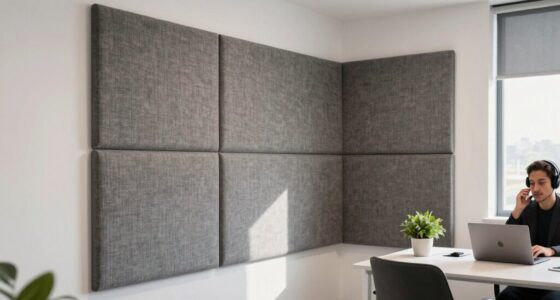
If your home office has lots of echo, a dynamic microphone may be better since it’s more resistant to ambient noise and echoes, focusing on your voice. Condenser mics capture richer, more detailed sound but can pick up more room reverberation, making them less ideal without proper acoustic treatment. To find out which option suits your space and needs, keep exploring the differences and solutions to improve your audio setup.

Get comfort and recovery gear delivered free with Prime
- Fast, free delivery on millions of items
- Prime Video, Amazon Music and more included
- Member-only deals all year
Key Takeaways
- Dynamic mics are better suited for echo-prone home offices due to their noise rejection and resilience to room reflections.
- Condenser mics capture richer sound but require acoustic treatment to reduce echo and background noise.
- For untreated rooms with echo, dynamic microphones help focus on speech and minimize ambient noise.
- Condenser mics excel in quiet, controlled environments but need proper room setup for optimal clarity.
- Choosing depends on room acoustics, budget, and willingness to implement sound treatments for best results.
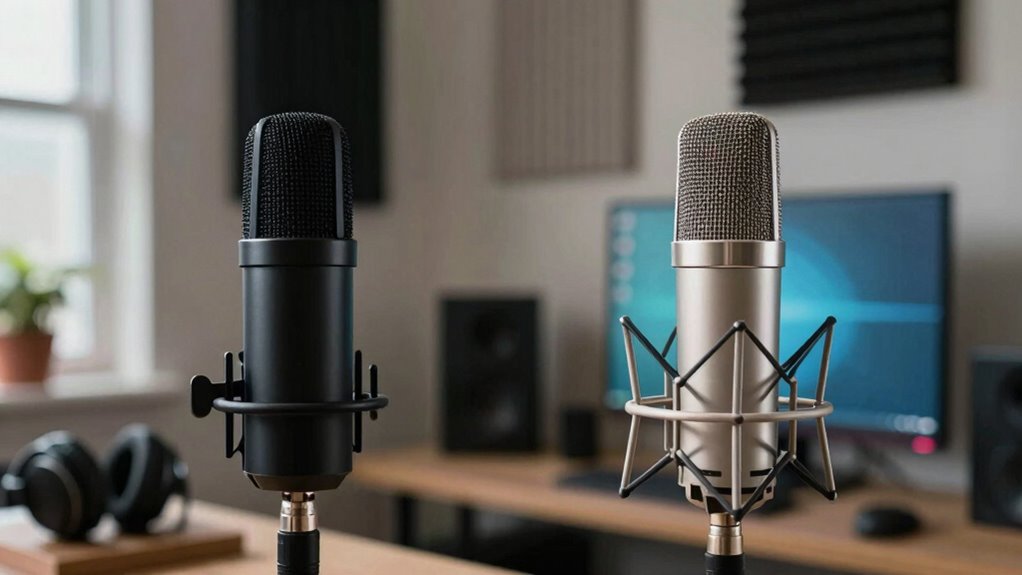
If you work from home and deal with echo or background noise, choosing the right microphone can substantially improve your audio quality. When you’re in a home office with reflective surfaces or nearby household sounds, your microphone’s ability to handle noise becomes critical. Understanding microphone types can help you make an informed decision. Dynamic and condenser microphones each have unique strengths and weaknesses, especially in environments with echo. Understanding how they differ in aspects like noise cancellation and frequency response can help you pick the best option for your setup.
Dynamic mics are generally more resilient to background noise and echo. They work by having a moving coil that responds mainly to sounds directly in front of the microphone. This design naturally limits ambient noise, making it easier to isolate your voice even if your room isn’t perfectly soundproofed. Their limited frequency response tends to focus on mid-range frequencies, which are essential for speech clarity, helping to cut through echo and room reverberation. Because of their robustness, dynamic microphones often excel in noisy environments, providing a more consistent audio signal with less need for additional noise cancellation tools. Additionally, their durability makes them suitable for everyday use in less controlled settings. When paired with noise cancelling technology, dynamic mics can further enhance sound quality in challenging environments.
Dynamic microphones excel in noisy spaces, naturally limiting ambient sounds for clearer voice recordings.
Condenser microphones, on the other hand, are known for their broader frequency response. They capture a wider range of sounds, including subtle nuances and high frequencies, resulting in richer, more natural audio. However, this sensitivity can be a double-edged sword. In a home office with echo, condenser mics tend to pick up more ambient noise, which can make your voice sound less clear unless you have a well-treated room. Without proper noise cancellation or acoustic treatment, the background noise might bleed into your recordings or calls, diminishing overall audio quality. Nevertheless, if your environment is relatively quiet or you’re willing to invest in soundproofing, a condenser mic can deliver professional-grade sound. Additionally, many condenser microphones come with advanced noise reduction features that can help mitigate ambient sounds in less-than-ideal spaces. Proper placement and acoustic treatment can also significantly improve the sound quality when using a condenser microphone. Furthermore, understanding the role of microphone polar patterns can help you optimize your microphone placement for better noise rejection.
In environments with echo, your choice hinges on balancing noise rejection and sound quality. Dynamic microphones typically require less effort to manage background noise, making them suitable for makeshift or untreated rooms. Conversely, condenser mics can provide superior audio detail but demand a quieter, more controlled environment to perform well. When selecting between the two, consider your room’s acoustics, your budget, and whether you’re willing to add acoustic treatments. If echo and background noise are persistent issues, a dynamic microphone with good noise cancellation features might be your best bet. If your space is relatively controlled, a condenser mic could deliver the richer, more detailed audio you need for professional calls or recordings.
best dynamic microphone for home office
As an affiliate, we earn on qualifying purchases.
As an affiliate, we earn on qualifying purchases.
Frequently Asked Questions
How Do Microphone Polar Patterns Affect Echo Reduction?
Your microphone’s polar pattern directly impacts echo reduction by controlling how sound is captured. With polar pattern flexibility, you can choose patterns like cardioid or hypercardioid that focus on your voice and reject background noise, including echoes. Additionally, understanding frequency response variation helps you select a mic that minimizes echo feedback. By optimizing these features, you improve clarity, making your home office sound clearer and more professional.
Can Microphone Placement Minimize Echo Issues Effectively?
In a manner of speaking, mic placement is your best bet for minimizing echo issues. You can enhance vocal warmth and noise cancellation by positioning your microphone close to your mouth and avoiding reflective surfaces behind or around you. Keep it slightly off-axis to reduce capturing room sound. Experimenting with placement helps you find the sweet spot, making your voice clearer and echo-free even in a challenging home office environment.
Are There Specific Accessories to Improve Mic Performance in Echoey Rooms?
Yes, you can improve mic performance in echoey rooms by adding accessories like acoustic panels and proper room treatment. Acoustic panels absorb excess sound reflections, reducing echo and background noise, which helps your microphone pick up clearer audio. Position these panels strategically around your workspace, especially near reflective surfaces, to create a more controlled environment. This simple step considerably enhances sound quality, regardless of your mic type.
How Do Power Requirements Differ Between Dynamic and Condenser Mics?
Dynamic mics don’t need phantom power, making them simpler and more versatile for home use. In contrast, condenser mics require phantom power and proper impedance matching to operate efficiently, which adds complexity. While dynamic mics handle echo better with less power, condenser mics deliver richer sound but need consistent power sources. Your choice depends on your setup’s power capabilities and sound quality preferences, especially in echoey environments.
What Are the Maintenance Needs for Each Microphone Type?
You’ll find that dynamic microphones generally need less maintenance because of their durability, making them ideal for frequent use. Condenser mics require more care, like keeping the capsule clean and protecting them from dust and moisture. When considering cost comparison, dynamic mics tend to be cheaper and more rugged, while condensers might need occasional repairs or replacements. Regular cleaning and proper storage help extend each microphone’s lifespan and maintain sound quality.
condenser microphone for voice recording
As an affiliate, we earn on qualifying purchases.
As an affiliate, we earn on qualifying purchases.
Conclusion
Choosing the right microphone can make or break your home office experience, especially if echo threatens to drown out your voice. Whether you opt for a dynamic or condenser mic, the power to cut through the chaos is in your hands. Don’t let echo turn your calls into a nightmare—grab the mic that suits you best and turn your home office into a professional sound sanctuary. Your voice deserves to be heard loud and clear—no matter what!
noise cancelling microphone for echo-prone rooms
As an affiliate, we earn on qualifying purchases.
As an affiliate, we earn on qualifying purchases.
home office soundproofing microphone
As an affiliate, we earn on qualifying purchases.
As an affiliate, we earn on qualifying purchases.
Fall Picks
fall essentials
As an affiliate, we earn on qualifying purchases.