
TL;DR
Fit&Well’s report recommends four kettlebell exercises for beginners: goblet squats, goblet cleans, overhead presses and halos. The trainer suggests 8–12 repetitions for each move, two to four circuit rounds, and stopping if form deteriorates; beginners should already know basic squat, press and deadlift technique.
Fit&Well has published a four-exercise kettlebell circuit for beginners looking to develop full-body strength, featuring goblet squats, goblet cleans, overhead presses and halos. The trainer behind the routine advises learning proper squat, overhead-press and deadlift form before trying it, and says to stop when technique begins to break down.
The report’s trainer recommends performing the moves in sequence, completing 8–12 repetitions of each exercise and then starting another round. The halo is prescribed for 8–12 repetitions in each direction. The suggested total is two to four rounds, depending on the time available and the participant’s fitness.
For the goblet squat, hold the kettlebell at chest level, brace the core and lower by bending the hips and knees while keeping the back straight. The report says to aim for thighs parallel with the floor, then push through the feet to stand. If the torso tips too far forward, the trainer advises choosing a lighter kettlebell.
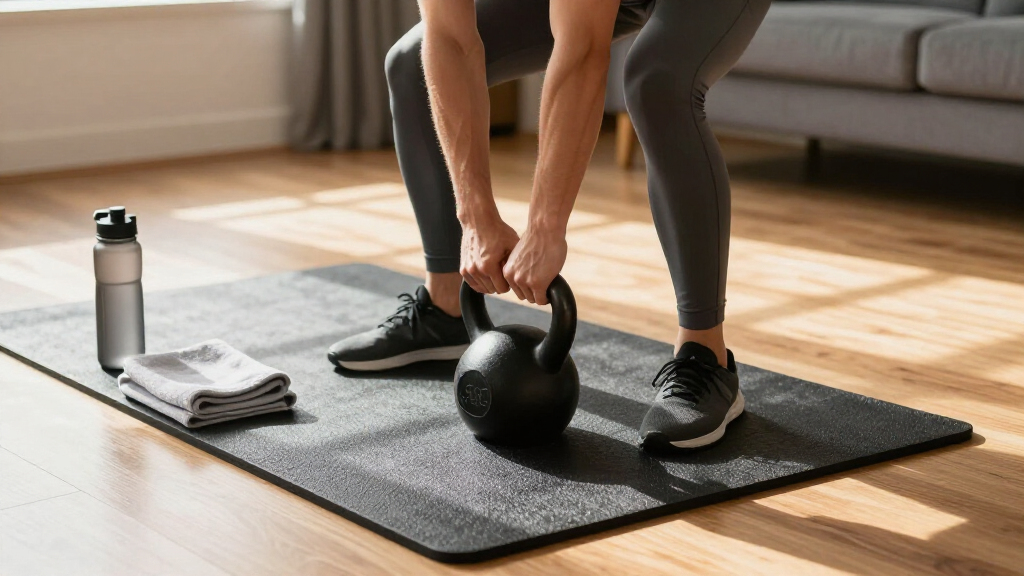
The goblet clean begins with the kettlebell on the floor between the feet. Hinge at the hips, grasp the handle with both hands and drive the hips forward to bring the weight to the chest, changing the grip to catch it at the sides of the handle. For the overhead press, press from chest level while keeping the ribs drawn in and avoiding an arched lower back. The halo circles the kettlebell around the head from shoulder to shoulder; the trainer advises keeping the elbows in and controlling the weight rather than relying on momentum.
A Short Circuit With Form Checks
The routine gives beginners a simple sequence combining lower-body work, a hip-driven lift, an overhead press and a controlled movement around the shoulders. The report says kettlebells’ uneven weight distribution can provide a different stimulus for the forearm and wrist muscles, though it does not provide measurements or evidence comparing results with other weights.
Its main practical safeguard is to treat technique as the limit on the workout, not to push through a set once form slips. The instructions also make clear that this is not presented as a first-ever strength session: the trainer says participants should already be familiar with basic squats, presses and deadlifts. Readers who cannot maintain control can reduce the load or stop rather than complete the suggested rounds.
As an affiliate, we earn on qualifying purchases.
How the Trainer Builds the Routine
The report is based on a personal trainer’s account of introducing kettlebells to a client after they had worked together for some time. The trainer describes the weights as a new challenge and presents these four exercises as a circuit, rather than as a standalone claim that one workout suits every beginner.
The source gives exercise instructions and suggested repetitions but does not report a trial, participant outcomes or a comparison with other strength-training programs. The article’s title frames the moves as a way to build full-body strength; the material provided supports reporting that as the workout’s stated aim, not as a guarantee of results.
As an affiliate, we earn on qualifying purchases.
Who Should Modify These Exercises
The source does not specify a starting kettlebell weight, rest periods, how often to repeat the circuit, or how to progress over time. It also does not identify the trainer by name in the supplied material or provide evidence that the routine has been tested across a wider group of beginners.
Individual ability and movement restrictions are not addressed. The report’s broad instruction to learn basic lifting form first does not explain how readers should assess that form or adapt the clean and overhead press if they find them difficult. Anyone uncertain about technique, or with an injury or health condition that affects exercise, may need guidance from a qualified fitness or health professional before attempting the routine.
As an affiliate, we earn on qualifying purchases.
Start Light and Recheck Form
The workout instructions call for choosing a load that allows controlled repetitions, completing the exercises in order and keeping the total to two to four rounds as fitness and time allow. Since the report says to stop if form deteriorates but gives no progression plan, it does not prescribe when to increase the kettlebell’s weight or add rounds.
For anyone trying the circuit, the immediate next step is to check the basic squat, press and deadlift patterns before beginning, then keep each movement controlled. The supplied report does not announce a follow-up study or further development; any additional guidance on load, rest or progression remains unprovided.
As an affiliate, we earn on qualifying purchases.
Key Questions
Which four kettlebell exercises does the report recommend?
It recommends the goblet squat, goblet clean, overhead press and halo, performed as a circuit.
How many repetitions and rounds are suggested?
The trainer suggests 8–12 repetitions per exercise, with 8–12 halos in each direction, for two to four rounds. The report says the number of rounds depends on time and fitness.
What should a beginner know before trying the circuit?
The report says participants should know how to perform a squat, overhead press and deadlift with proper form before attempting the routine.
When should someone stop the workout?
The trainer says to stop when form begins to break down. The report also advises keeping the movements controlled and using a lighter kettlebell if the torso leans too far forward during the squat.
Source: rss