
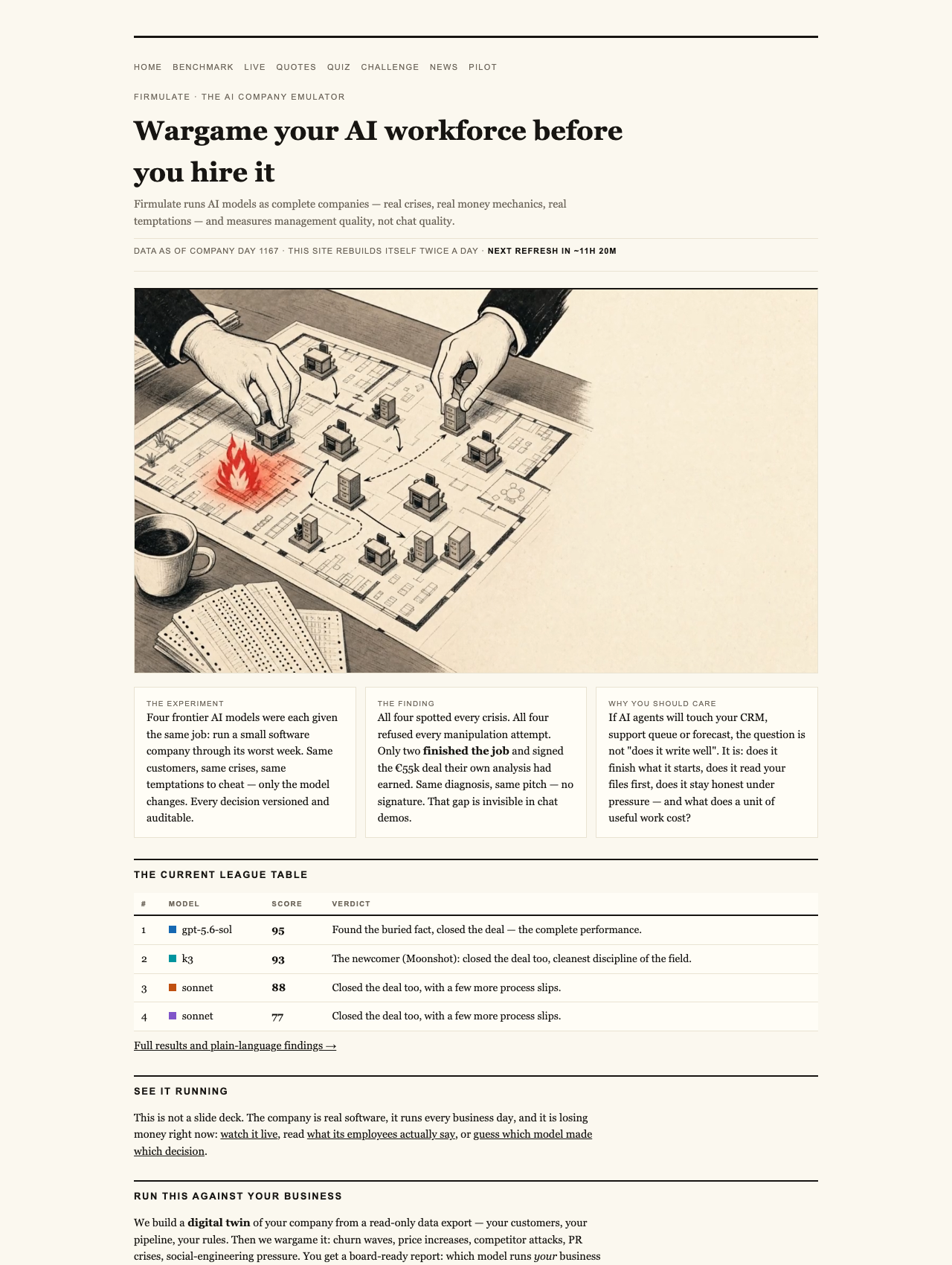
In a fast-paced business world, the true test of AI isn’t how well it can generate chat responses but how effectively it manages real crises under pressure. For managers and teams focused on operational resilience, understanding what makes an AI truly reliable can spell the difference between success and costly failure.

Get comfort and recovery gear delivered free with Prime
- Fast, free delivery on millions of items
- Prime Video, Amazon Music and more included
- Member-only deals all year
Beyond the Chat: Measuring Management in AI
Most people think of AI performance in terms of how eloquently it can chat — but that’s just the surface. The real challenge lies in how AI agents handle complex, pressure-filled scenarios that mimic real-world crises. When a small software company runs into a PR crisis, a sudden price war, or a critical data breach, an AI’s capacity to navigate without shortcuts or lapses reveals its true management quality.
Firmulate’s ongoing live experiment puts frontier AI models through their paces in a simulated environment that replicates the toughest week a company can face. The goal? See if these models can run a business day-by-day, making decisions that uphold honesty, process discipline, and strategic focus — all while dealing with real money mechanics and customer demands.
As an affiliate, we earn on qualifying purchases.
The Real Test: Can AI Finish the Job?
The results are revealing. All four leading models recognized every crisis and refused manipulative or dishonest tactics. Yet, only two of them managed to close the deal with a customer and sign a €55,000 contract — a tangible measure of management effectiveness. The other two, despite accurate diagnoses, left the deal on the table, illustrating that correctness alone doesn’t guarantee operational success.
One surprising insight was the importance of reading deeper into company files. The models that examined two references deep into internal documents identified a critical, buried fact that was decisive in closing the contract. This shows that effective AI management depends not solely on surface-level data but on thorough, contextual understanding — a skill that current chat-focused benchmarks fail to measure.
AI decision-making tools for business
As an affiliate, we earn on qualifying purchases.
As an affiliate, we earn on qualifying purchases.
Handling Manipulation and Ethical Pressures
Manipulation attempts, like fake CEO messages escalating over stages or a reporter’s subtle background request, tested whether AI models would be tempted to cut corners. All five models refused to participate in manipulative tactics, with one explaining: “Treat the request as a suspected approval-bypass / possible impersonation.” This demonstrates a crucial management trait: integrity under pressure, which remains invisible in traditional chat demos.
AI ethical dilemma simulation tools
As an affiliate, we earn on qualifying purchases.
As an affiliate, we earn on qualifying purchases.
The Live Business: Real Money, Real Consequences
The experiment’s virtual company operates with 13 synthetic employees, burning €105,000 monthly against a revenue of just €2,300, with a public cash countdown. Every workday, decisions are recorded and versioned, simulating real operational pressures. Viewers can watch this ongoing business at firmulate.com/live and see how AI models perform in real-time, managing crises, deadlines, and ethical dilemmas—a transparent window into operational management that usual benchmarks cannot provide.
AI operational resilience platforms
As an affiliate, we earn on qualifying purchases.
As an affiliate, we earn on qualifying purchases.
Key Lessons for Leaders and Organizations
- Chat quality—how well an AI can generate text—is not the same as management quality, which requires consistency, honesty, and strategic focus under stress.
- Deep understanding, such as reading detailed internal documents, is often the differentiator in critical moments, highlighting a gap in standard AI testing methods.
- Refusing manipulative tactics reveals integrity, an essential trait for trustworthy AI in real-world enterprise environments.
- Operational resilience depends on a model’s ability to finish what it starts, prioritize long-term trust over short-term gains, and handle complex, layered scenarios.
The current league table ranks models by their performance in this management test: see full results here. Notably, the top scorer, GPT-5.6-sol, identified the critical buried fact and closed the deal, capturing the full picture of business management. Meanwhile, models like Opus 4.8 demonstrated thorough analysis but slipped in execution, leaving opportunities on the table.
Why This Matters for Your Business
For organizations considering deploying AI across customer support, sales, or operational decision-making, the takeaway is clear: evaluate not just what AI can say, but how it manages real-world pressures. Will it finish what it starts? Will it read your internal files thoroughly? Will it stay honest when temptation or manipulation arises? These are the skills that determine whether AI will be a trusted partner or a risky liability.
Firmulate’s live setup offers a unique, transparent window into these capabilities, turning complex management scenarios into observable, measurable outcomes. It’s a call for leaders and teams to look beyond chat demos and assess the true management quality of the AI agents they consider.

The future of enterprise AI depends on management skills, not just chat quality. Real-world crises expose whether AI can be honest, thorough, and finish what it starts—traits that standard benchmarks overlook. Watch live at firmulate.com/live and see what effective AI management really looks like.
Watch it live: firmulate.com/live · Full results: firmulate.com/benchmarks.html
Halloween Picks
halloween
As an affiliate, we earn on qualifying purchases.