TL;DR

Get comfort and recovery gear delivered free with Prime
- Fast, free delivery on millions of items
- Prime Video, Amazon Music and more included
- Member-only deals all year
Fit&Well published a yoga therapist’s seven-part seated movement routine for older adults and people who prefer or need chair-based exercise. The therapist describes the movements as gentle and adaptable; the report does not provide clinical evidence that the routine improves health outcomes.
Fit&Well has published a seven-part chair-based movement routine recommended by a yoga therapist who works with older adults, including people living with Parkinson’s disease, other movement disorders and chronic health conditions. The sequence offers a seated option for people who cannot comfortably move on the floor or simply prefer a chair, but it is presented as general exercise guidance, not as a treatment or a clinically tested program.
The therapist describes using chair-based yoga with people whose mobility limits floor exercise, as well as with participants who feel more comfortable moving while seated. In the report, the therapist says the practice involves stretching muscles, mobilizing joints and mindful movement, and that participants may feel calmer and more uplifted afterward. These are the therapist’s observations about their classes, not outcomes established by the article through research or a clinical trial.
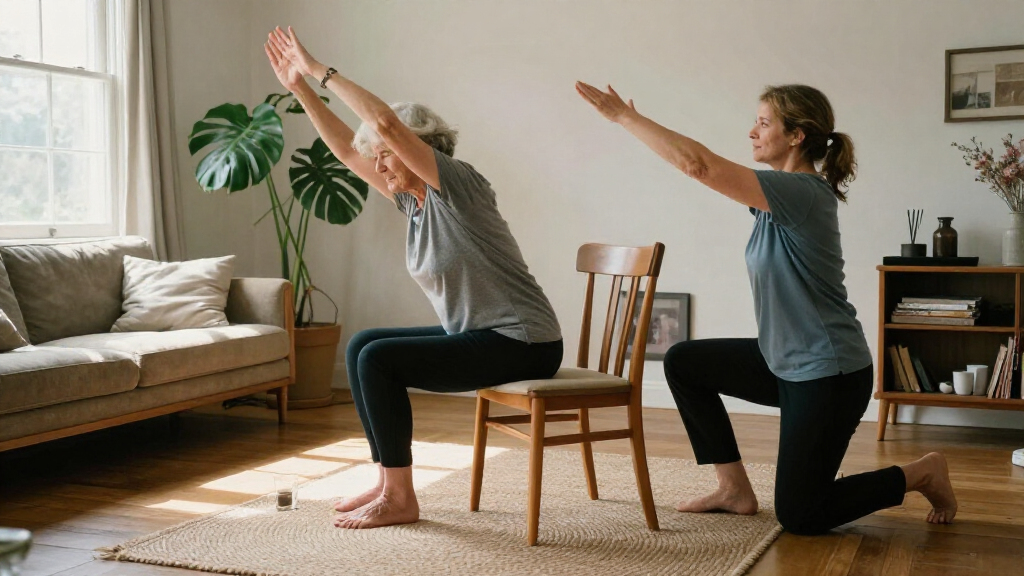
The proposed flow begins with a minute of settling: sit toward the back of a sturdy chair, place both feet flat on the floor, keep the chest upright and let the breath find a natural rhythm. It then moves through arm arcs into prayer, seated twists, arm raises and side bends. The therapist suggests three to five repetitions for several movements and three per side for twists and bends.
The last two movements are seated cat-cow and a forward fold, each suggested for three to five repetitions. For cat-cow, participants alternate between lifting the chest and looking up, then rounding the back and lowering the head. During the fold, they hinge the upper body forward and return upright. The report advises keeping the movement within each person’s accessible range; it also offers modifications, including holding the chair for support during a side bend and placing the hands on the knees during a forward fold.
A Seated Option for Gentle Movement
The routine matters as a practical example of how movement can be adapted for people who may find floor-based exercise difficult or uncomfortable. A chair can provide a familiar base for a sequence involving the upper body, spine and breathing, while the suggested modifications give readers alternatives to some positions. That can make the instructions easier to approach for older adults or people managing mobility limitations, though the report does not establish that the routine is safe or suitable for every individual.
The therapist’s emphasis is on comfort and personal range rather than achieving a particular pose. That framing avoids presenting flexibility or a specific shape as a measure of success. Readers should still use a stable chair on a clear surface, move slowly, and stop if they feel pain, dizziness, unusual shortness of breath or unsteadiness. People with health conditions, recent injuries, balance concerns or questions about exercise should seek guidance from a qualified health professional before trying a new routine.
The source gives no measurements of energy, mobility or other effects, and no comparison with other forms of exercise. Its value for readers is therefore chiefly instructional: it lays out a short, adaptable series of movements and explains the therapist’s approach, rather than reporting proof of a particular benefit.
Popular right now

De'Longhi Magnifica XS ECAM22110B Automatic Espresso Machine

Vitamix 5200 Professional-Grade Blender, 64 oz. Container, Black

Samsung 75-Inch M80H Series Mini LED 4K Smart TV (2026)
As an affiliate, we earn on qualifying purchases.
How the Seven Moves Are Structured
The source is a Fit&Well report framed around exercises recommended by a yoga therapist. The therapist says their work mainly involves older adults living with Parkinson’s, other movement disorders and chronic health conditions. They describe keeping the postures gentle while still aiming for a session participants find energizing. The report does not name a particular study, medical organization or exercise guideline underpinning the sequence.
The routine is designed for a sturdy chair and enough clear space to raise the arms. After settling into the seat, participants link movement with breathing: inhale for actions such as raising the arms or returning upright, and exhale for actions such as lowering the hands, twisting or folding forward. The sequence moves from upper-body reaches to gentle spinal movement and a seated forward fold.
Several instructions are explicitly optional or adaptable. Looking up at the hands is suggested only if comfortable, and the therapist says people should move within their own capacity rather than aiming for a fixed position. The article offers chair support for the side bend and hands-on-knees support for the fold, but does not give individualized variations for every condition.
“I encourage everyone to move within the range and capacity of their body—there’s no particular shape or position to achieve.”
— The yoga therapist quoted in Fit&Well
Evidence and Individual Suitability
The report does not state when the article was published, provide study results or assess whether the flow improves mobility, energy, pain or other health outcomes. It also does not give detailed safety guidance for specific diagnoses, medications, recent surgery or different levels of balance and mobility. The therapist’s descriptions of participants feeling calmer, rested or uplifted are attributed observations, and the source does not establish how often those responses occur.
It is also unclear whether the sequence has been reviewed by clinicians for each condition mentioned or whether it was designed for people to follow without supervision. The instructions call for a sturdy chair and accessible movement, but those measures cannot determine whether every exercise is appropriate for an individual. Anyone unsure should check with a clinician or qualified exercise professional familiar with their needs.
Trying the Sequence Safely
The Fit&Well report presents the sequence as an option readers can try with a stable chair and clear space, using the listed repetitions as a guide rather than a requirement. A cautious approach is to begin with comfortable, small movements, keep the feet supported, and use the suggested chair or knee support where needed. Readers should stop if a movement causes pain, dizziness or other concerning symptoms.
The source does not announce a follow-up study, clinical review or scheduled update. The next step for anyone considering the routine is to decide with a health professional whether the movements fit their circumstances, especially if they have a chronic condition, a movement disorder, recent injury or fall risk. Any further evidence about the sequence’s effects or suitability would require information beyond the report.
Key Questions
What exercises are included in the chair routine?
The seven parts are a brief seated settling practice, arm arcs into prayer, seated twists, single and double arm raises, side bends, cat-cow and a forward fold. The therapist suggests a minute for settling and generally three to five repetitions for several movements.
Who is the routine intended for?
The therapist describes chair-based yoga as an option for people who cannot comfortably do floor-based movement and those who prefer a chair. Their classes include older adults and people with Parkinson’s, other movement disorders and chronic health conditions. The report does not say that the sequence is suitable for everyone in those groups.
What equipment or space is needed?
The report calls for a sturdy chair and enough clear space around it to raise the arms comfortably. Keep the chair on a stable surface and choose a position that allows the feet to rest flat on the floor if possible.
Can the movements be modified?
Yes. The therapist says to work within an individual’s range and capacity rather than trying to achieve a particular pose. The report suggests holding the chair during a side bend for extra support and keeping the hands on the knees during the forward fold.
Does the report show that the routine improves health?
No clinical findings or measured health outcomes are provided. The therapist reports that participants may feel calmer, rested or uplifted, but those are attributed observations rather than proven effects. People with health concerns should ask a qualified professional whether the movements are appropriate for them.
Source: fitandwell.com