To stop reaching for your mouse and save your shoulder, keep your mouse close to your keyboard and within easy reach. Adjust your workspace so your mouse is at the same height as your keyboard, and position essential items nearby to avoid twisting or stretching. Use a mouse pad with wrist support for comfort, and regularly check your setup to make certain your arm stays relaxed and close to your body. If you want more tips, keep exploring.
Key Takeaways
- Position your mouse close to your keyboard to minimize arm extension and prevent reaching.
- Keep the mouse at the same height as your keyboard for a neutral wrist position.
- Use a mouse pad with wrist support to maintain a relaxed, natural hand and wrist posture.
- Adjust your workspace so the mouse remains within a comfortable, easy-to-reach area without twisting your shoulder.
- Regularly re-evaluate and modify your setup to ensure consistent, ergonomic mouse placement and posture.
Top picks for "stop reach mouse"
Open Amazon search results for this keyword.
As an affiliate, we earn on qualifying purchases.
Assessing Your Current Workspace Layout
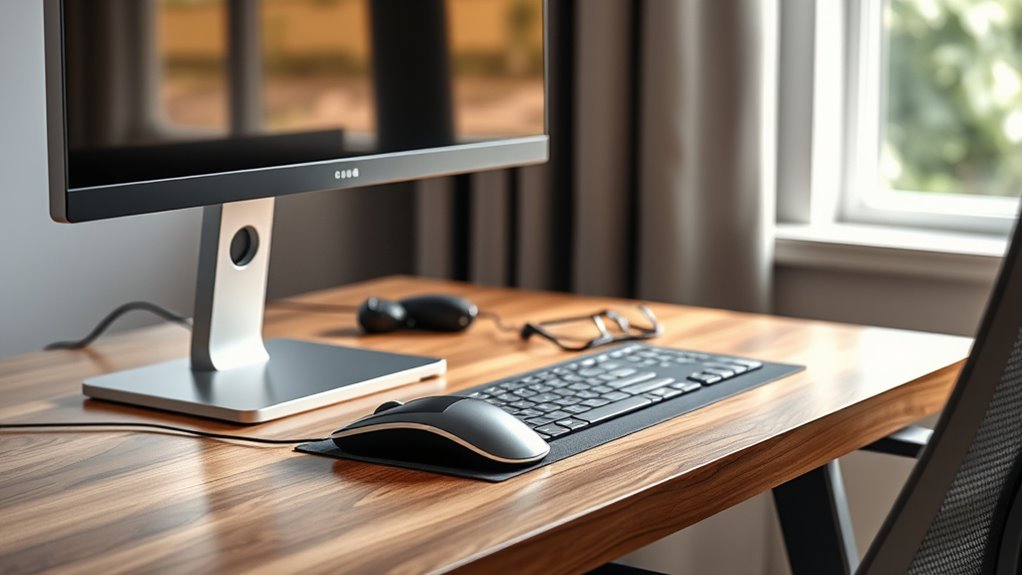
Before making any adjustments, take a close look at your current workspace layout. Check how your desk is arranged and where your mouse, keyboard, and monitor are positioned. Is your mouse close enough to your body so you don’t have to reach? Are your elbows resting comfortably at your sides? Notice if your monitor is at eye level to prevent neck strain. Identify any clutter or obstacles that might force you to stretch or twist awkwardly. evaluate your chair height and how it aligns with your desk. Make sure your workspace supports a natural posture, with your arms relaxed and your wrists in a neutral position. Assessing these elements helps you understand what needs changing to reduce shoulder strain.
Positioning Your Mouse for Optimal Reach
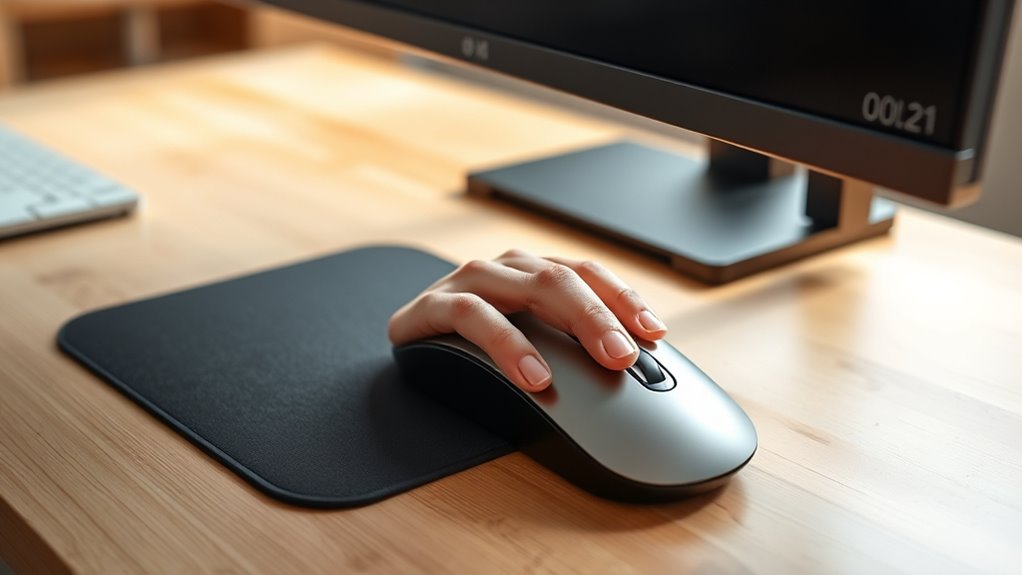
To reduce shoulder strain, it’s essential to position your mouse so it’s within easy reach without stretching or twisting your arm. Keep it close enough that your elbow stays near your body, and your wrist remains straight. Avoid reaching across your desk or extending your arm. Use a simple layout like this:
| Mouse Position | Arm Placement | Wrist Alignment |
|---|---|---|
| Close to keyboard | Elbow at your side | Neutral, straight wrist |
| Level with keyboard | Relaxed shoulder | Avoid wrist bending |
| Slightly below surface | Forearm supported | Keep wrist aligned |
This setup minimizes movement and keeps your shoulder relaxed, reducing fatigue and discomfort. Proper positioning is key to maintaining good ergonomics and preventing longer-term issues.
Adjusting Your Desk and Chair Height

You should set your desk to a height where your elbows stay close to your sides and your forearms are parallel to the floor. Adjust your chair so your feet rest flat and your knees are at a comfortable angle. Keeping these in check helps maintain ergonomic alignment and reduces shoulder strain.
Proper Desk Height
Finding the right desk height is essential for maintaining good posture and reducing shoulder strain. Your desk should be at a height where your elbows are bent at about 90 degrees, and your forearms are parallel to the floor. If your desk is too high, your shoulders might hunch; too low, and you’ll lean forward. Use this table to find your ideal height:
| Your Height | Recommended Desk Height |
|---|---|
| Short (under 5’4”) | Just below elbow level |
| Average (5’4”–5’9”) | At elbow height |
| Taller (over 5’9”) | Slightly above elbow level |
| Arm Position | Keep forearms parallel to the floor |
| Posture Tip | Relax shoulders, avoid shrugging |
Adjustable Chair Position
Since your chair and desk need to work together to support proper posture, adjusting their heights guarantees your body remains aligned and comfortable. Set your chair so your feet rest flat on the floor with your knees at a 90-degree angle. Your hips should be level with or slightly higher than your knees. Adjust the chair height so your hips are supported and your lower back maintains natural curve. Make certain your thighs are parallel to the ground, and your shoulders stay relaxed. Your elbows should rest comfortably at your sides, forming about a 90-degree angle. When your chair and desk are correctly adjusted, you reduce strain on your shoulders, neck, and back, creating a stable, ergonomic foundation for your workspace.
Maintain Ergonomic Alignment
To uphold ergonomic alignment, guarantee your desk and chair are adjusted so your monitor is at eye level, and your keyboard and mouse are within easy reach. Proper setup keeps your shoulders relaxed and reduces strain. Make certain your chair height allows your feet to rest flat on the floor, with knees at a 90-degree angle. Your monitor should be about an arm’s length away, directly in front of you. Keep your wrists straight and your elbows close to your sides. Regularly check your posture to avoid slouching or leaning forward.
- Adjust chair height for feet flat on the ground
- Position monitor at eye level to prevent neck strain
- Keep keyboard and mouse close to avoid reaching
- Maintain elbows at 90 degrees
- Use lumbar support to support your lower back
Using a Mouse Pad With Wrist Support
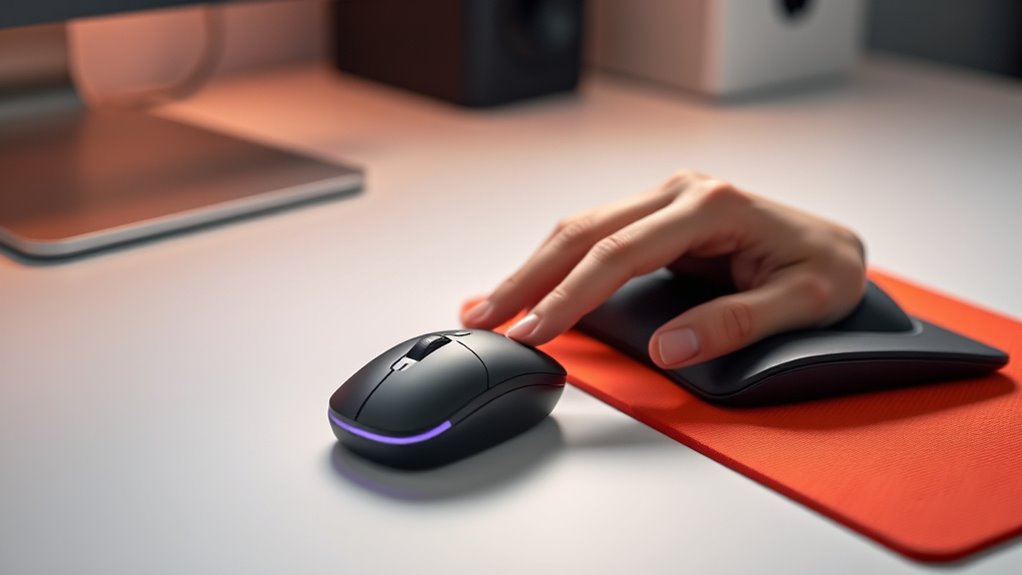
Using a mouse pad with wrist support can considerably reduce shoulder strain by encouraging a more natural arm position. It also enhances wrist comfort, making long hours at your computer less tiring. Plus, maintaining proper posture with the right support helps prevent discomfort and injury over time.
Reduces Shoulder Strain
A mouse pad with wrist support can considerably reduce shoulder strain by promoting better hand and arm positioning. When your wrist rests comfortably on the pad, your arm stays closer to your body, decreasing the need to reach forward or upward. This alignment minimizes tension in your shoulder muscles and prevents overextension. Proper positioning also encourages a neutral arm posture, reducing awkward angles that cause fatigue. Additionally, wrist support helps maintain consistent hand height, avoiding unnecessary lifting or lowering of your arm. This stability allows your shoulder muscles to relax and work more efficiently. By keeping your arm closer and more aligned, you lessen the strain on your shoulder joint, promoting long-term comfort and reducing the risk of discomfort or injury.
- Keeps your arm closer to your body
- Prevents reaching forward
- Promotes neutral arm posture
- Reduces overextension
- Maintains consistent hand height
Enhances Wrist Comfort
Wrist support on your mouse pad directly enhances wrist comfort by providing a soft, stable surface that reduces pressure and strain during extended use. This cushion helps keep your wrist in a neutral position, preventing awkward angles that can cause pain or fatigue. By minimizing tension, you can work longer without discomfort. To better understand, consider this table:
| Benefit | Explanation |
|---|---|
| Pressure Reduction | Soft support minimizes pressure points |
| Improved Alignment | Keeps wrist aligned with forearm |
| Fatigue Prevention | Less strain leads to fewer aches |
Using a mouse pad with wrist support effectively cushions your wrist, making prolonged tasks more comfortable and reducing the risk of repetitive strain injuries.
Promotes Proper Posture
Although maintaining proper posture is essential for comfort and health, many people neglect the role their mouse setup plays in supporting it. Using a mouse pad with wrist support helps keep your wrist in a neutral position, reducing strain and encouraging better overall alignment. This minimizes shoulder tension caused by reaching or awkward movements. Proper positioning ensures your arm remains relaxed and your wrist remains stable. To promote good posture, consider these tips:
- Keep your mouse close to avoid reaching
- Use a wrist support pad for added stability
- Maintain a slight angle between your wrist and forearm
- Keep your elbow close to your body
- Regularly adjust your setup for comfort
These simple adjustments help you stay aligned and prevent discomfort over time.
Keeping Essential Items Within Arm’s Reach

Keeping essential items within arm’s reach is key to maintaining a comfortable and efficient workspace. When your keyboard, phone, notepad, and other frequently used tools are close by, you avoid unnecessary reaching or twisting. Position your most-used items on your desk directly in front of you or within a few inches. This setup reduces strain on your shoulder, neck, and back by minimizing movement. Keep supplies organized in accessible containers or trays to prevent clutter. Regularly assess your workspace to ensure everything you need is easily obtainable. By keeping essentials nearby, you can work more comfortably, stay focused, and prevent repetitive strain injuries. A simple, organized setup supports your posture and keeps your shoulder relaxed during long work sessions.
Implementing Ergonomic Accessories and Tools
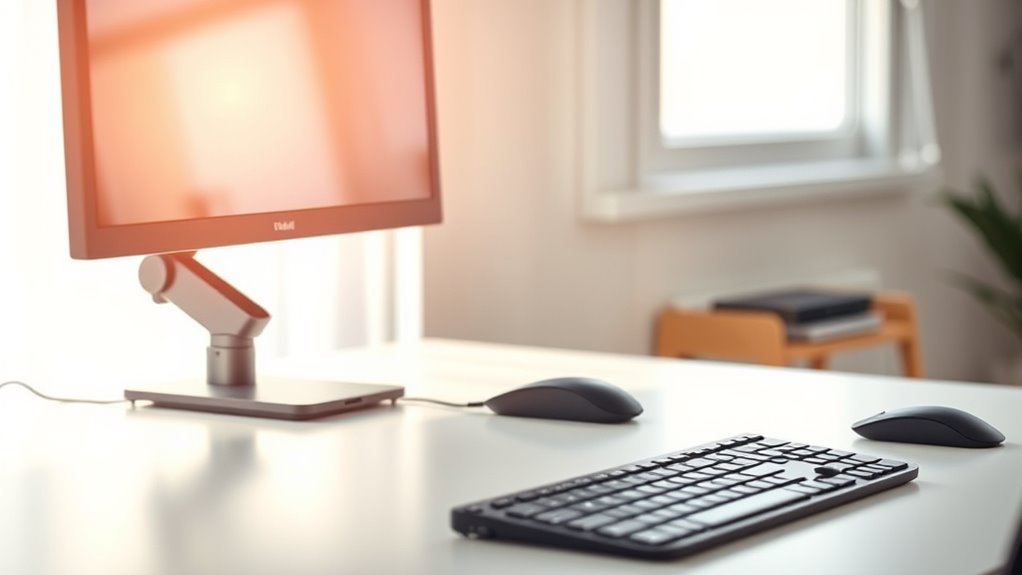
Implementing ergonomic accessories and tools can considerably enhance your comfort and reduce strain during long work sessions. These tools help position your body correctly and minimize repetitive stress. Consider adding a wrist rest to support your wrists and prevent fatigue. An adjustable keyboard tray allows you to set your keyboard at a comfortable height, reducing shoulder tension. A monitor riser elevates your screen to eye level, encouraging good posture. Using a document holder keeps reference materials within easy reach, avoiding awkward neck movement. Finally, a footrest can improve overall posture and reduce lower back strain. Incorporate these accessories into your workspace to promote natural positioning, decrease reaching, and prevent shoulder discomfort, making your work sessions more comfortable and sustainable.
Creating a Consistent Mouse Placement Routine

Establishing a consistent mouse placement routine is essential for maintaining ergonomic comfort and preventing strain. Start by always positioning your mouse in the same spot on your desk, ideally close to your body to reduce reaching. Use a designated area on your desk or a mouse pad to create a habit. Keep your wrist straight and your hand relaxed as you place the mouse down. Consistency helps your muscles remember the proper posture, reducing tension over time. Adjust your workspace so that your mouse naturally falls into this spot when you sit down. Make this routine part of your daily setup, and you’ll minimize unnecessary movements and strain. Over time, this simple habit can markedly improve comfort and decrease shoulder fatigue.
Incorporating Breaks and Movement Into Your Day
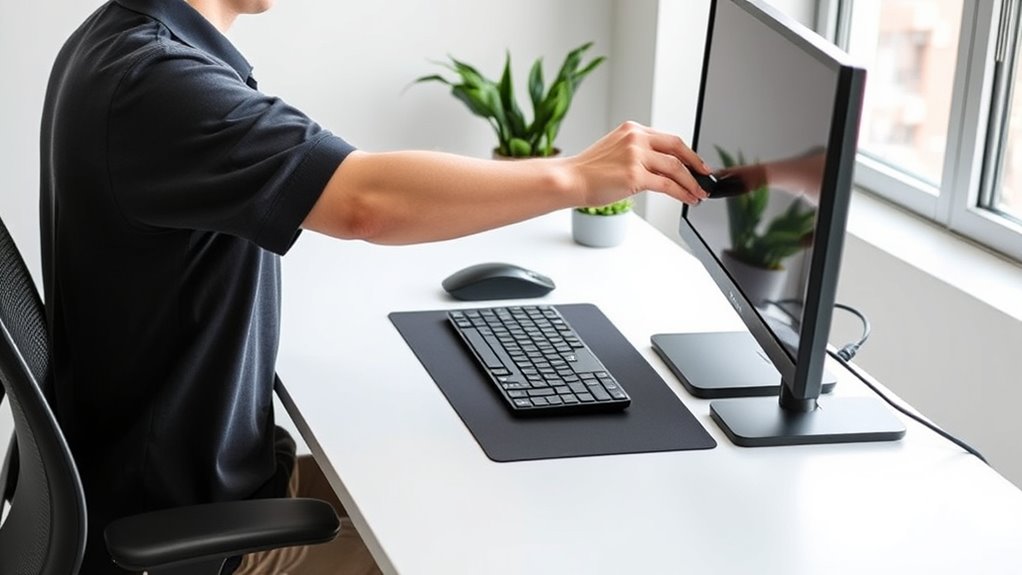
To protect your shoulder, you need to build movement into your day. Schedule regular breaks, do quick stretches, and set reminders to move. These simple steps help prevent stiffness and keep your muscles fresh.
Schedule Regular Breaks
Have you ever noticed how quickly your focus wanes when you sit at your desk for hours? Regular breaks help you stay alert and reduce shoulder strain. By scheduling short pauses, you prevent muscle fatigue and maintain productivity. Use a timer or set reminders to prompt you to stand or move every 30 to 60 minutes. During breaks, try to:
- Stand up and stretch your arms and shoulders
- Walk around the room or office
- Perform deep breathing exercises
- Shift your focus away from the screen
- Hydrate to stay refreshed
These small actions break up long periods of sitting and encourage blood flow. Consistent breaks help you avoid reaching, overusing muscles, and developing discomfort over time. Make break scheduling a non-negotiable part of your routine.
Incorporate Stretching Routines
Building on the importance of regular breaks, incorporating simple stretching routines into your day can further reduce shoulder strain and improve overall comfort. Take a few minutes every hour to stretch your shoulders, neck, and arms. For example, gently roll your shoulders backward and forward to loosen tight muscles. Reach your arm across your chest and hold it with the opposite hand to stretch your shoulder. Elevate your arms overhead and clasp your hands to stretch your upper back. These quick movements help release tension accumulated from continuous mouse use. Consistent stretching not only relieves muscle tightness but also promotes better circulation, preventing stiffness and discomfort. Make stretching a routine part of your workday, and your shoulders will thank you for it.
Use Movement Reminders
Since prolonged mouse use can lead to muscle fatigue and discomfort, incorporating movement reminders into your daily routine is essential. Setting timers or alarms helps you remember to stand, stretch, or walk around. These small breaks prevent stiffness and improve circulation, reducing strain on your shoulder and arm. You can also use apps or sticky notes as visual cues to prompt movement. Consider the following ideas:
- Set a timer to stand and stretch every 30 minutes
- Use a reminder app to prompt you to take short walks
- Place sticky notes on your monitor as visual cues
- Schedule quick shoulder rolls or neck stretches during breaks
- Incorporate deep breathing exercises to relax muscles
These reminders guarantee you stay active, helping to prevent discomfort and maintain good posture throughout your workday.
Tips for Maintaining Good Posture While Working
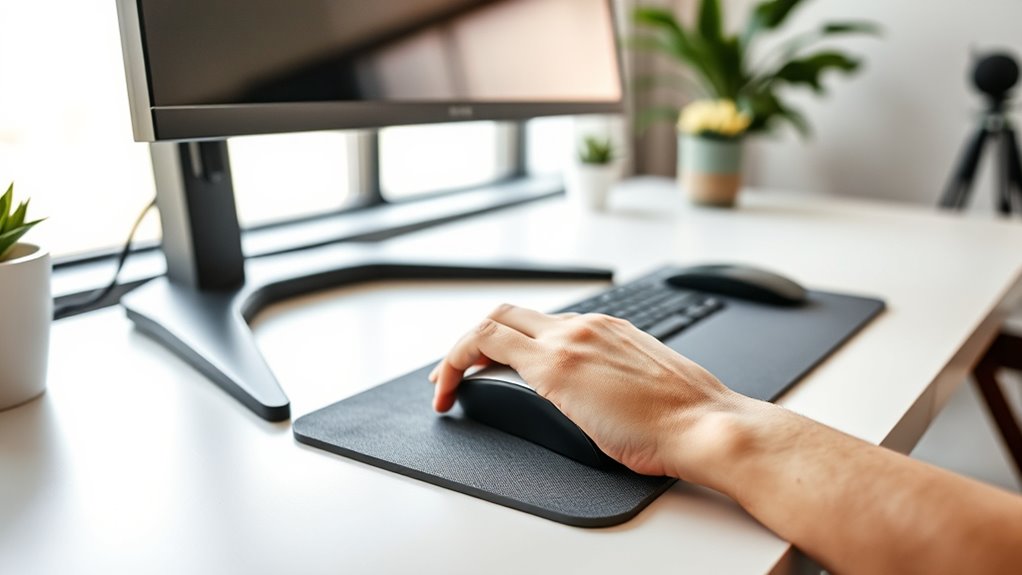
Maintaining good posture while working is essential to prevent strain and discomfort over time. Sit with your feet flat on the floor and your knees at a 90-degree angle. Keep your back straight and supported by your chair’s lumbar support. Position your monitor at eye level so you don’t strain your neck. Keep your shoulders relaxed and avoid hunching forward. Your elbows should be close to your sides, forming about a 90-degree angle, with your wrists straight while using your mouse and keyboard. Take regular breaks to stretch and shift positions. Stay mindful of your posture throughout the day, as slouching or leaning can lead to muscle tension. Good habits now will help you stay comfortable and prevent long-term pain.
Regularly Re-evaluating and Adjusting Your Setup
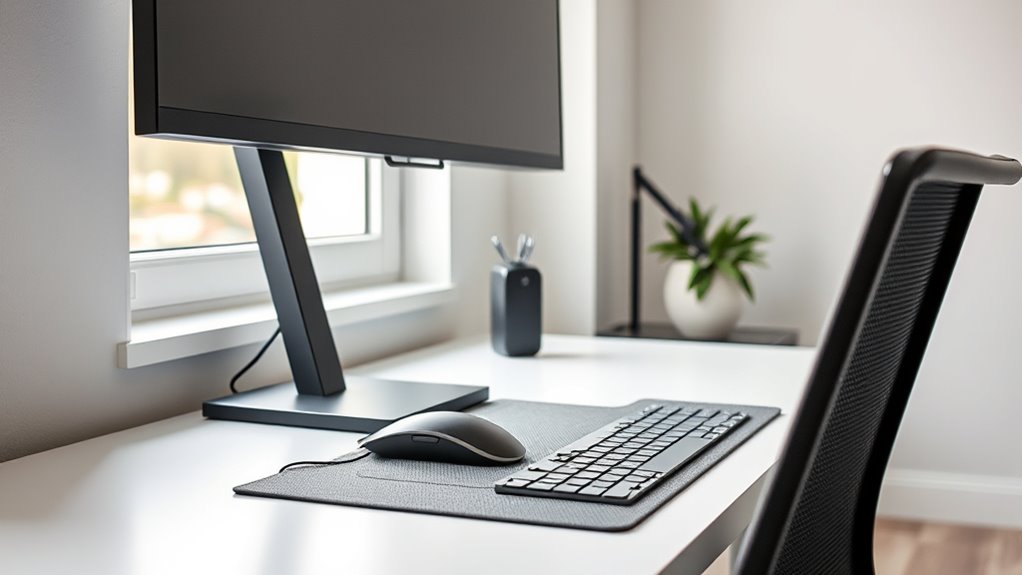
Regularly re-evaluating and adjusting your setup guarantees your workspace remains ergonomic as your needs change. Over time, your posture, tasks, and equipment may shift, making it essential to fine-tune your workspace. Check if your mouse position still minimizes reaching and shoulder strain. Ensure your monitor height keeps your neck relaxed. Confirm your keyboard and mouse are aligned correctly. Adjust chair height for proper leg and back support. Small tweaks can prevent discomfort and boost productivity.
- Reassess your mouse placement frequently
- Adjust monitor height as needed
- Change chair position for better support
- Rotate or reposition your keyboard
- Take regular breaks to stretch and evaluate comfort
Frequently Asked Questions
How Can I Tell if My Current Mouse Setup Is Causing Shoulder Strain?
You can tell if your mouse setup causes shoulder strain by noticing persistent pain or discomfort in your shoulder, neck, or upper back after working. If you find yourself reaching or stretching your arm frequently, or if your shoulder feels tense or sore, these are signs. Additionally, if your arm or shoulder tire quickly or you experience numbness, it’s time to reassess your setup to prevent further strain.
Are There Specific Ergonomic Accessories Recommended for Small Workspaces?
In small workspaces, ergonomic accessories are your secret weapon against discomfort. Consider a compact, adjustable keyboard stand to keep your wrists at a natural angle, or a corner mouse pad that minimizes reach. A dual-purpose monitor stand can free up desk space and improve posture. These essentials can transform your cramped area into a haven of comfort, making your workspace feel like a well-oiled ergonomic masterpiece.
How Often Should I Re-Evaluate My Workspace Setup for Comfort?
You should re-evaluate your workspace setup every few months or whenever you notice discomfort. Regular checks help guarantee your workstation remains ergonomic as your needs or equipment change. Pay attention to signs like neck strain, shoulder pain, or fatigue, and adjust accordingly. Staying proactive ensures you maintain comfort and prevent long-term injuries. Make it a habit to assess and optimize your setup regularly for ongoing support and efficiency.
What Signs Indicate My Posture Needs Correction During Work?
You should correct your posture if you notice persistent neck or shoulder pain, frequent headaches, or tingling in your arms or hands. Also, if you find yourself slouching, leaning forward, or experiencing discomfort after long periods of work, it’s a sign to adjust. Pay attention to how your body feels; discomfort or fatigue often indicate your posture needs realigning for better support and reduced strain.
Can Adjusting My Monitor Position Improve My Overall Ergonomic Setup?
Adjusting your monitor position can substantially improve your ergonomic setup. For example, if you lower your monitor so the top of the screen is at eye level, you’ll reduce neck strain and avoid leaning forward. This way, you maintain a neutral posture, lessening shoulder and back discomfort. Proper monitor height encourages better alignment, making your workspace more comfortable and helping prevent long-term musculoskeletal issues.
Conclusion
By fine-tuning your workspace, you’re gently guiding your shoulder away from unnecessary strain, like steering a delicate boat through calm waters. Small adjustments—keeping your mouse close and your posture steady—help you glide smoothly through your workday, avoiding rough patches. With mindful tweaks and regular check-ins, you’ll create a comfortable harbor for your arm, making each session feel less like a reach and more like a steady hand guiding you forward with ease.