
TL;DR

Get comfort and recovery gear delivered free with Prime
- Fast, free delivery on millions of items
- Prime Video, Amazon Music and more included
- Member-only deals all year
Fit&Well describes a home leg workout built around four equipment-free exercises, performed for 30 seconds each in a circuit. The report suggests five rounds for a 15-minute session, while beginners can start with three rounds and extra rest; individual ability and form remain important.
Fit&Well has published a 15-minute home leg workout using four bodyweight exercises and no equipment, offering a short routine for people who cannot get to a gym. The report recommends doing each movement for 30 seconds, resting after the full circuit and repeating it, with beginners advised to start with fewer rounds and more rest.
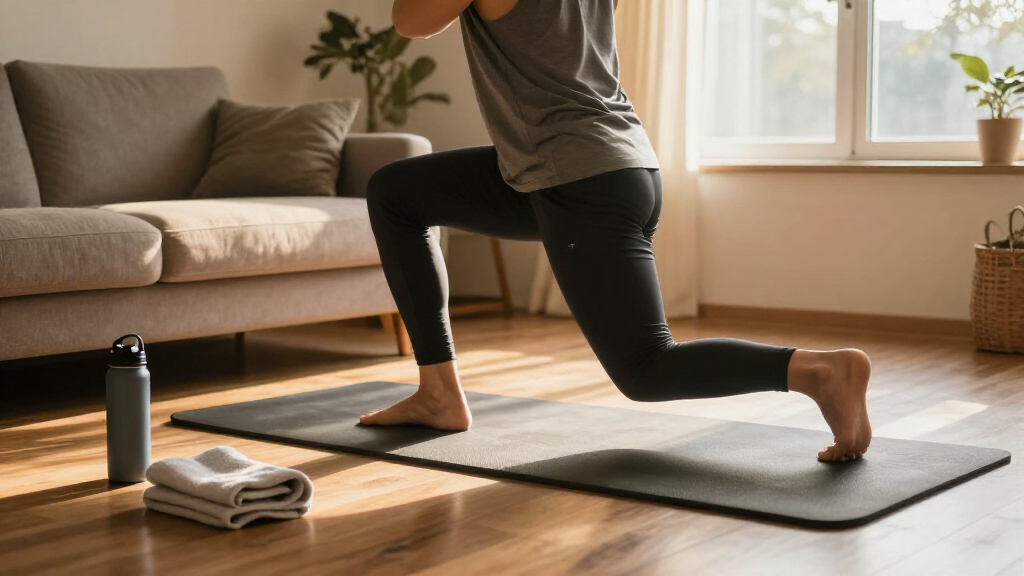
The circuit consists of squats, reverse lunges, glute bridges and lateral lunges. Each exercise is performed for 30 seconds before moving to the next. After completing all four, the routine calls for a one-minute rest before the circuit begins again. Fit&Well says completing five rounds should take about 15 minutes.
The report recommends a lower starting volume for new exercisers: three full circuits, with additional rest between exercises. It suggests gradually reducing those rest periods and increasing the number of rounds as strength and conditioning improve. These are the report’s workout instructions, not a guarantee of a particular strength or fitness outcome.
Form advice includes keeping the chest upright during squats and lunges, keeping the front knee aligned with the foot during reverse lunges, and avoiding a lower-back arch during glute bridges. For lateral lunges, the report says to keep the toes pointing forward. It advises beginners to seek help from a personal trainer for instruction or modifications and says people who feel sharp pain should stop and speak with a doctor.
A Short Routine Without Gym Gear
The workout gives readers a compact option for exercising at home when time or access to a gym is limited. Because it uses bodyweight movements and needs only a small amount of open space, it does not require purchasing or setting up equipment. Its timed format also makes the sequence and session length straightforward to follow.
The routine covers several movement patterns: squatting, stepping backward, moving laterally and raising the hips from the floor. That makes it more varied than repeating a single exercise, though the source does not provide research or measured results showing how much strength a reader will gain. The practical value depends on a person’s ability to perform the movements safely and consistently.
Its beginner guidance matters because the report acknowledges that exercises described as not very advanced can still challenge someone new to training. Starting with three rounds, taking more rest and using support for balance can make the session easier to manage. Readers should treat those adjustments as ways to scale the routine, not as a substitute for individualized advice when they have an injury or health concern.
Popular right now

Dyson Cyclone V10 Origin Cordless Vacuum

Vitamix Propel Series 510 Professional-Grade Blender, 3 Programs, Black

TCL 85 Designer Series QD-Mini LED TV (Model 85A400U) with Google Smart TV
As an affiliate, we earn on qualifying purchases.
How the Four-Move Circuit Works
The source report presents the workout as an alternative for days when a gym visit is impractical. It describes a time-based circuit, rather than assigning a fixed number of repetitions: each movement lasts 30 seconds, followed by the next exercise. A one-minute break comes after the fourth movement.
During squats, the instructions are to stand with feet hip-width apart, lower by bending the hips and knees, and rise again. Reverse lunges alternate sides, with a step backward and a controlled bend in both knees. For glute bridges, the exerciser lies on their back with knees bent, lifts the hips and lowers them. Lateral lunges alternate sides, shifting weight toward one bent leg while the other remains straight.
The report gives modifications and technique cues, including using a chair or another stable structure for balance during lunges. It also says a glute bridge can be done on a bed or couch if getting onto the floor is not possible. These are suggestions from Fit&Well’s report; they are not a clinical assessment of whether the exercises are suitable for any particular reader.
“All you’ll need to do the routine is a little bit of space to move—no equipment required.”
— Fit&Well report
Who Should Modify the Exercises
The source does not state when the report was published, provide evidence measuring the workout’s results, or specify how many calories or how much strength a person might gain. The claim that five rounds should take 15 minutes is an estimate based on the described timing; the actual duration may vary with transitions and rest.
It is also not clear whether the full circuit is appropriate for people with existing injuries, balance limitations or other health conditions. The report recommends trainer guidance for beginners and medical advice if sharp pain occurs, but it does not give individualized screening or modifications for specific conditions. Readers should not interpret the routine as a personalized exercise plan.
Start With a Manageable Number of Rounds
Readers following the report can begin with three rounds and extra rest, then adjust the pace and number of circuits gradually if the exercises remain comfortable and controlled. The report does not set a timetable for increasing the workload, so progression should depend on the individual rather than a fixed schedule.
Anyone unsure about technique can consult a qualified trainer, as the source recommends. Stop if sharp pain occurs and seek medical advice. Fit&Well’s report does not announce a follow-up study or further update; the next step for readers is deciding whether the routine suits their own ability and circumstances.
Key Questions
What exercises are in the 15-minute workout?
The circuit includes squats, reverse lunges, glute bridges and lateral lunges, each performed for 30 seconds.
How many rounds does the report recommend?
Fit&Well says five rounds should take about 15 minutes, with a one-minute rest after each full circuit. Beginners are advised to start with three rounds and add rest between exercises.
Does the workout require equipment?
No. The report says the routine needs only a small amount of space and no equipment. It suggests a chair or stable structure for balance support during lunges if needed.
What should someone do if an exercise causes sharp pain?
The report says to stop immediately and speak with a doctor if sharp pain occurs. People with health concerns or injuries may want professional guidance before starting.
Source: fitandwell.com