
TL;DR

Get comfort and recovery gear delivered free with Prime
- Fast, free delivery on millions of items
- Prime Video, Amazon Music and more included
- Member-only deals all year
A Fit&Well report describes three coordination exercises a trainer uses with older adults: opposite-arm knee raises, side steps with opposite-arm reaches, and a ball catch-and-throw drill. The trainer says the movements can be adjusted for standing or seated practice; the report does not provide new research or claim that the exercises prevent disease or guarantee longer life.
Fit&Well has published a trainer’s guide to three coordination exercises used with older adults, presenting standing and seated versions of each. The report says the trainer includes the movements in chair-based yoga classes and personal training sessions to practise coordinated movement, balance and control in everyday activities.
The exercises pair movements on opposite sides of the body or combine movement with catching and throwing. The trainer recommends five to six repetitions on each side for the knee raise and side step, and five to 10 throws for the ball drill. These are the report’s suggested practice amounts, not a clinical prescription.
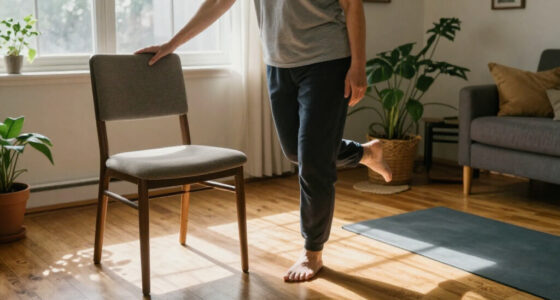
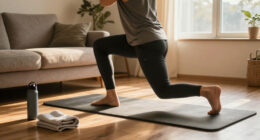
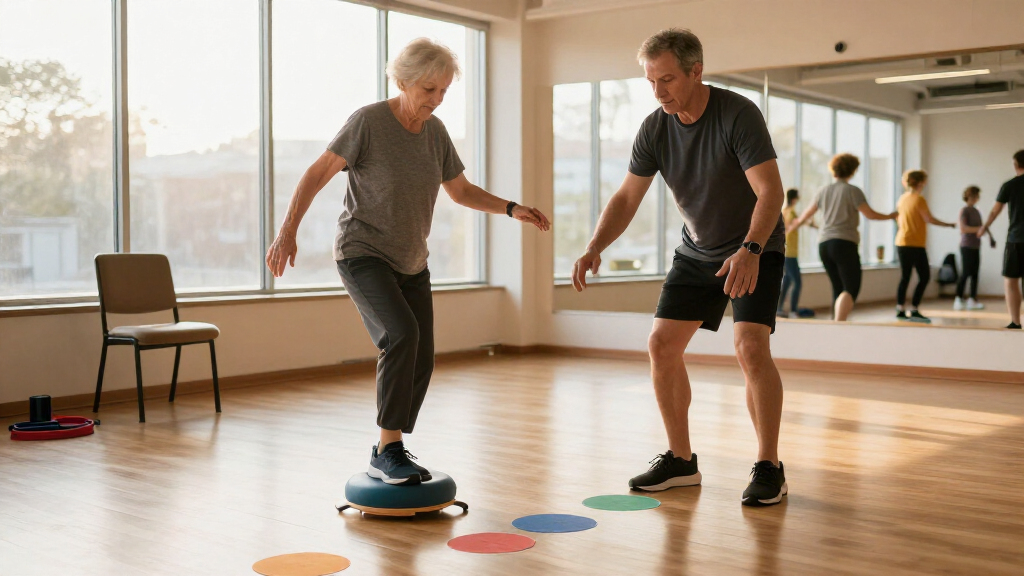
For the first exercise, a participant raises one knee while bringing the opposite arm forward. The standing version starts with feet hip-width apart and arms out at shoulder height; the seated alternative is a controlled march with the opposite arm raised in front or overhead. The second exercise adds a side step and opposite-arm reach. People who find a side lunge uncomfortable can step out without lowering, while the seated option uses a side step-out and opens the opposite arm to the side.
The final drill involves bouncing a ball gently off a wall and catching it while balancing on one leg. The report suggests using one or two hands and varying the direction of the throw. It also describes simpler options: stand on both feet or do the drill seated. Each movement can be adapted to a person’s mobility and ability, according to the trainer.
Coordination for Everyday Movement
The report focuses on a practical aspect of exercise: coordinating the limbs while maintaining posture and reacting to movement. The trainer links these skills to tasks such as moving around other people on public transport and handling more than one activity at home. That is the trainer’s rationale for including the exercises; the article does not establish that this specific routine improves independence or prevents falls.
Fit&Well cites a 2019 review of balance and coordination exercises in older adults, which it says found improvements in cognitive processes such as spatial awareness, as well as postural control and stability in distracting environments. The supplied material does not give the review’s authors, title, participant numbers or effect sizes, so readers cannot assess those details from this report alone. The finding is broader than the three exercises featured and should not be read as evidence that this particular sequence produces the same effects.
The practical value of the guide is that it offers standing and seated variations, allowing the movements to be scaled rather than treated as all-or-nothing tasks. Anyone unsure whether an exercise is appropriate for them, particularly if they have health conditions or balance concerns, can seek advice from a qualified health professional or exercise specialist before trying it.
Popular right now

Dyson V8 Cordless Vacuum

Shark AI Ultra Robot Vacuum with Self-Empty Base

Ninja Foodi 10-Qt DualZone Smart XL Air Fryer, 6-in-1, DZ550
As an affiliate, we earn on qualifying purchases.
How the Routine Is Adapted
The trainer says coordination work is included in both chair-based yoga classes and personal training for older adults. The report contrasts this with strength training, describing coordination as another kind of exercise that may support ageing well rather than a replacement for strength work.
Its central adaptation is to change the position or difficulty while keeping the coordination task. A knee lift can become a seated march; a lateral step can become a seated side reach; and a one-leg ball drill can be performed with both feet grounded or from a chair. The report also suggests changing the ball’s size or using one or two hands. It does not set out a progression schedule, a weekly frequency, or a requirement that readers complete all three drills in one session.
““I always incorporate coordination training into my chair-based yoga classes and personal training sessions with older adults.””
— The trainer quoted in Fit&Well
Evidence and Safety Limits
The supplied report does not identify the trainer by name or provide the date of publication. It also does not include the full citation or methods for the 2019 review, making it unclear which exercise programmes were studied or how large the reported effects were. No trial of the three featured exercises is described, and the article gives no evidence that they extend lifespan or prevent falls.
The guide does not specify how often to practise, how to increase difficulty over time, or what support someone with substantial balance limitations may need. Individual capacity varies, and the article’s seated alternatives do not by themselves confirm that every movement is suitable for every reader. People with existing conditions or a history of falls may want professional guidance before starting.
Applying the Exercises Safely
The report offers the movements as adaptable examples rather than a formal programme with a prescribed schedule. Readers who choose to try them can begin with the version that matches their current ability, use a stable setup, and stop if they feel unsteady or unwell. Anyone uncertain about safe modifications can ask a qualified exercise professional or health professional for individual advice.
No additional study, follow-up, or scheduled update is identified in the supplied material. Further information would be needed to establish how frequently these exercises should be done, whether the routine improves the outcomes described, and which groups of older adults may benefit most.
Key Questions
Which coordination exercises does the report recommend?
It describes opposite-arm knee raises, side steps paired with an opposite-arm reach, and a ball-bouncing catch-and-throw drill.
Can the exercises be done while seated?
Yes. The report gives seated alternatives for all three: a controlled march with an opposite-arm raise, a side step-out with an arm opening, and a seated ball drill.
How many repetitions does the trainer suggest?
The guide suggests five to six repetitions per side for the first two exercises and five to 10 throws for the ball drill. It does not prescribe how often to do the routine.
Does the report show these exercises prevent falls or extend life?
No. The report describes a trainer’s practice and refers to a 2019 review of balance and coordination exercises, but it does not show that these three exercises prevent falls or extend lifespan.
Source: rss