To guarantee your cable labels still work after six months, choose durable materials like laminated vinyl or laminated tags that resist wear and moisture. Apply labels firmly near connection points using clear, concise descriptions, and use color coding for quick identification. Regularly cross-reference with diagrams or spreadsheets to stay organized. Proper application and durable materials keep labels legible and intact over time—if you want detailed tips, you’ll find more helpful strategies below.

Get comfort and recovery gear delivered free with Prime
- Fast, free delivery on millions of items
- Prime Video, Amazon Music and more included
- Member-only deals all year
Key Takeaways
- Use durable, weather-resistant labels like laminated tags or vinyl to prevent fading and peeling over six months.
- Attach labels firmly near connection points, avoiding areas prone to bending or friction to ensure longevity.
- Utilize permanent markers or printed labels for clear, consistent, and long-lasting readability.
- Incorporate color coding or numbering to facilitate quick identification even after months.
- Maintain documentation and periodically check labels to confirm they remain intact and legible over time.

Keeping your cables organized can be a challenge, but a reliable labeling system makes all the difference. When it comes to wire management, the way you label your cables plays a fundamental role in maintaining order and preventing confusion over time. Effective labeling techniques ensure that even months later, you can quickly identify each cable without guessing or untangling a mess. The key is to choose methods that are durable, clear, and easy to apply so that your system remains functional long after the initial setup.
A reliable labeling system keeps cables organized, clear, and easy to identify over time.
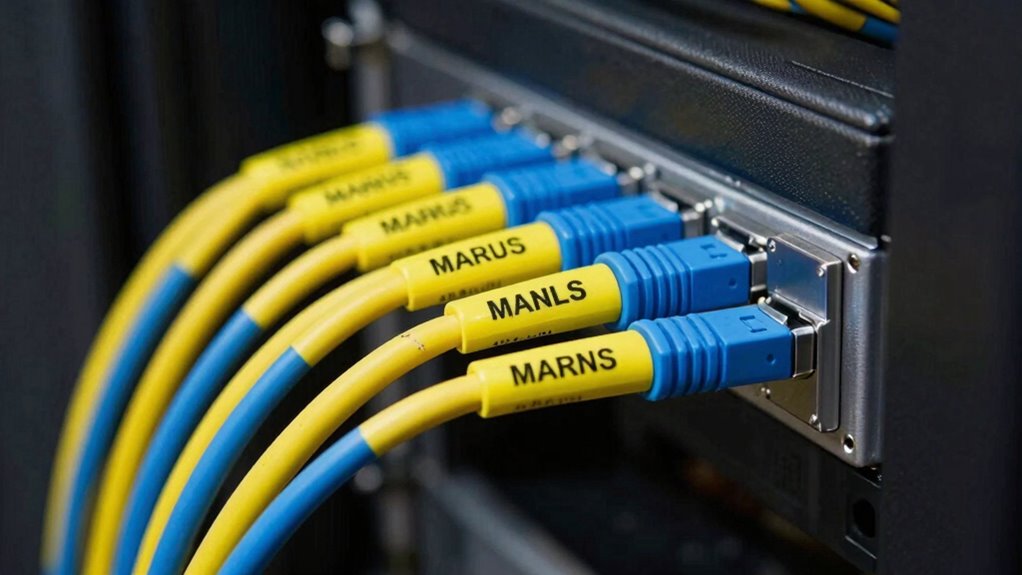
Start by selecting label materials designed for longevity. Vinyl labels or laminated tags resist wear, moisture, and fading, which are common issues that can compromise your labeling efforts over time. Using a durable material means your labels won’t peel off or become illegible after several months. When applying labels, make sure they’re firmly affixed in a visible spot close to the cable’s end or connector, avoiding areas prone to bending or friction that could cause them to detach prematurely.
In terms of labeling techniques, simplicity works best. Use concise, descriptive language—like “Printer,” “Monitor,” or “Router”—so you can identify each cable at a glance. Numbering cables in sequence or grouping them into categories can also save you time if you have a large number of cables. For example, numbering all cables connected to your server rack as “Server 1,” “Server 2,” helps you locate specific connections fast. Color coding can also complement your labels—using colored tags or tapes to differentiate between data, power, or peripheral cables adds an extra layer of clarity.
Consistency in your labeling approach is vital. Decide on a format and stick with it. Whether you prefer handwritten labels with a permanent marker or printed labels from a label maker, maintain the same style across all cables for uniformity. This consistency makes it easier to scan your setup and find the right cable quickly, especially months down the line when the labels might have accumulated dust or slight wear.
Another tip is to document your cable layout in a simple spreadsheet or diagram. Cross-referencing your labels with a written record allows you to troubleshoot or reconfigure without guesswork. Over time, your system should evolve with your needs, but the core principles—durable labels, clear labeling techniques, and consistency—remain the foundation of effective wire management. Understanding cable labeling systems and their importance can help you optimize your setup for long-term reliability. When you follow these practices, your cable labeling system will not only be reliable today but continue to serve you well months into the future.
As an affiliate, we earn on qualifying purchases.
Frequently Asked Questions
Can the Labeling System Be Reused on New Cables?
Yes, you can reuse the labeling system on new cables. The label durability guarantees they stay intact and legible over time, making reapplication straightforward. To reuse them, simply clean the labels if needed, peel them carefully without damaging, and reapply using the same adhesive or a new adhesive if necessary. This process saves you time and money while maintaining clear, professional cable management.
Is the Labeling System Suitable for Outdoor or Humid Environments?
You might wonder if this labeling system can withstand the elements. Rest assured, it’s designed for outdoor and humid environments with weatherproof durability and humidity resistance. You’ll find it maintains against rain, dew, and moisture, preserving clarity and adhesion over time. Its robust construction guarantees your labels stay in place, even in challenging conditions. So yes, you can confidently use it outdoors without worrying about deterioration or losing critical information.
How Resistant Are the Labels to Extreme Temperatures?
You’ll find the labels highly resistant to extreme temperatures thanks to their thermal durability, which allows them to withstand both hot and cold conditions without fading or peeling. Their strong adhesive ensures they stay firmly attached, even when exposed to temperature fluctuations. You can confidently use these labels in environments with significant thermal variations, knowing they’ll maintain their clarity and adhesion over time, ensuring your cable management remains organized and reliable.
What Is the Maximum Number of Labels That Can Be Applied?
You can apply up to 1,000 labels with this system, like stars in a clear night sky. Its label durability and adhesive strength guarantee each one stays put, no matter how busy your setup gets. The robust adhesive bonds securely, preventing peeling or slipping over time. So, go ahead and label away — this system’s strength keeps your cables organized and your workspace shining bright, day after day.
Are There Any Special Tools Required for Applying or Removing Labels?
You typically don’t need any special tools for applying or removing labels. For label removal, a gentle adhesive remover or your fingernail usually suffices, making tool necessity unnecessary. When applying labels, guarantee the surface is clean for better adhesion, but no tools are needed. If labels are stubborn during removal, a plastic scraper can help, but generally, no specialized tools are required for either process.
As an affiliate, we earn on qualifying purchases.
Conclusion
So, if you want a labeling system that outlives even your wildest cable tangles and never, ever lets you guess which wire is which, this method is your hero. It’s like the superhero of cable organization—saving you from chaos for months on end. Trust me, once you try it, you’ll wonder how you ever survived without it. Say goodbye to cable confusion forever and enjoy a perfectly tidy setup that laughs in the face of time!
As an affiliate, we earn on qualifying purchases.
As an affiliate, we earn on qualifying purchases.
Fall Picks
fall essentials
As an affiliate, we earn on qualifying purchases.