TL;DR

Get comfort and recovery gear delivered free with Prime
- Fast, free delivery on millions of items
- Prime Video, Amazon Music and more included
- Member-only deals all year
Fit&Well has published a dumbbell lunge routine that pairs forward, side and curtsy lunges as a weekly lower-body workout. The report recommends 6–8 repetitions per side for each move and two or three sets, while allowing bodyweight or dumbbells; it does not present research showing that this exact schedule is superior.
Fit&Well has published a weekly leg-workout sequence built around forward, side and curtsy lunges, with dumbbells optional. The report recommends six to eight repetitions per leg for each variation and two or three sets, presenting the routine as a way to work the glutes and other lower-body muscles; it does not establish that once-weekly training is the best schedule for building strength.
The routine combines three lunge patterns rather than relying on forward movement alone. Fit&Well says the variations place the legs and hips under load in different directions and can involve the gluteus maximus, gluteus medius and gluteus minimus, alongside other lower-body muscles. The article’s author describes lunges as a complement to squats, not a replacement for them.
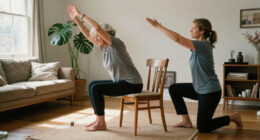
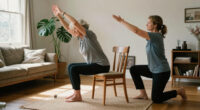
For each move, the suggested volume is two or three sets of six to eight reps per side. A forward lunge begins from a hip-width stance: step forward, bend both knees while keeping the chest upright, then push through the front foot to stand. The side lunge steps laterally; the stepping knee bends while the other leg stays straight. In the curtsy lunge, one foot crosses behind the other before both knees bend. The report advises lowering only as far as is comfortable in the side lunge.
Fit&Well says the workout can be done with bodyweight or dumbbells. A dumbbell may be held at each side, on the shoulders, or as a single weight at the chest, according to the report. It recommends a bodyweight round before weighted work and increasing the load gradually. People who find alternating repetitions difficult for balance can complete the repetitions on one side before switching. The article also suggests adjusting repetitions so the final few feel challenging, rather than requiring a particular weight.
How the Three Lunges Broaden the Workout
The practical distinction is the routine’s use of forward, lateral and cross-behind movement. That gives readers a compact alternative to a session centered on one squat or lunge pattern, while offering ways to scale the workout to different equipment levels. The report describes the muscles’ roles: the gluteus maximus contributes to movements such as walking and standing, while the gluteus medius and minimus help move the thigh and stabilize the pelvis.
Fit&Well also says side and curtsy lunges engage muscles and ligaments connecting the core and lower spine, and that loading the hips and ankles in different directions may support mobility and stability. Those points are presented as the author’s explanation and experience, not as measured outcomes from a clinical study. The author notes having found the sequence helpful after rehabilitation following a bulging-disc diagnosis; that personal account does not show the routine is appropriate treatment for back problems.
For readers, the key takeaway is that the sequence offers a specific, adjustable workout template, not a guaranteed result. Strength gains depend on factors including training load, technique, consistency and recovery. The source provides no comparison between once-weekly training and more frequent sessions, and no data on how much glute strength or muscle size participants gained.
Popular right now

Shark Clean & Empty Cordless Stick Vacuum with Auto-Empty System, BU3521

Vitamix Propel Series 750 Professional-Grade Blender, 4 Programs, Black

De'Longhi 15-Bar Pump Espresso Machine with Milk Frother & Temperature Control
As an affiliate, we earn on qualifying purchases.
The Routine’s Sets and Movement Choices
The article presents lunges as one way to train the lower body alongside squats. Its rationale is that changing direction can recruit the hip muscles in ways that a forward-facing squat may not emphasize to the same degree. The source does not cite a head-to-head study comparing these three lunges with squats, so this is the report’s training rationale rather than a quantified finding.
The routine is framed for use as part of a broader weekly program or as a short standalone session. Fit&Well’s author says they sometimes do it at the end of the workday. The exercise guidance begins with a bodyweight warm-up round if adding dumbbells, then suggests building the load gradually across sets or over several weeks. No specific dumbbell weight, rest period, weekly progression plan or total workout duration is provided.
Each exercise uses the same general repetition range, but the movement differs. The forward lunge steps ahead; the side lunge moves outward and sends the hips back; the curtsy lunge crosses a foot behind the standing leg. The report advises maintaining an upright chest and controlling the knee bend. These cues are general instructions, not individualized coaching, and the source does not include a screening process for injuries or mobility limitations.
““There’s another leg exercise I do to target parts of the glutes that squats don’t reach: the lunge.””
— Fit&Well report author
What the Workout Evidence Does Not Show
The source is a fitness report describing an exercise routine, not a study testing it. It does not provide evidence that doing these lunges once a week will build strong glutes, how quickly results might appear, or whether that frequency suits different training histories. The headline’s promise should be read as the report’s fitness framing, not a guaranteed outcome.
It is also unclear what load or range of motion is appropriate for an individual reader. The article supplies general form cues but does not assess balance, existing pain, mobility, or injury history. Its author’s experience during recovery from a back condition is personal and does not establish that the exercises are safe or beneficial for others with spinal concerns.
How Readers Can Apply the Routine
The report gives readers a starting format rather than a fixed progression: try a bodyweight round, use a comfortable range of motion, and add resistance gradually if the movements are controlled. It recommends two or three sets of six to eight reps per side for each variation. The source does not specify how often to raise the weight or when to increase the number of sets.
Anyone with persistent pain, a recent injury, balance concerns or a pre-existing medical condition should seek guidance from a qualified health professional before adding loaded lunges. If the routine is included in a wider program, readers can adjust its place and volume according to their overall training and recovery. Fit&Well has not announced follow-up testing or additional evidence for the once-weekly schedule in the supplied material.
Key Questions
What exercises are in the workout?
The sequence includes forward lunges, side lunges and curtsy lunges. Each variation is prescribed for six to eight repetitions on each leg.
How many sets does Fit&Well recommend?
The report recommends two or three sets of each lunge variation. It does not give a specific rest period or workout duration.
Do you need dumbbells?
No. Fit&Well says the exercises can be done with bodyweight or dumbbells. For weighted work, the report suggests warming up with a bodyweight round and increasing resistance gradually.
Does the report prove that one workout a week builds glutes?
No. The source presents a weekly routine but does not report a study or measured results showing that this schedule builds glute strength or muscle size, or that it is better than other training frequencies.
What if balance or an existing condition is a concern?
The report suggests completing all repetitions on one side before switching if alternating makes balance difficult. People with pain, injury history or a pre-existing condition should consult a qualified health professional about appropriate exercise and technique.
Source: fitandwell.com